

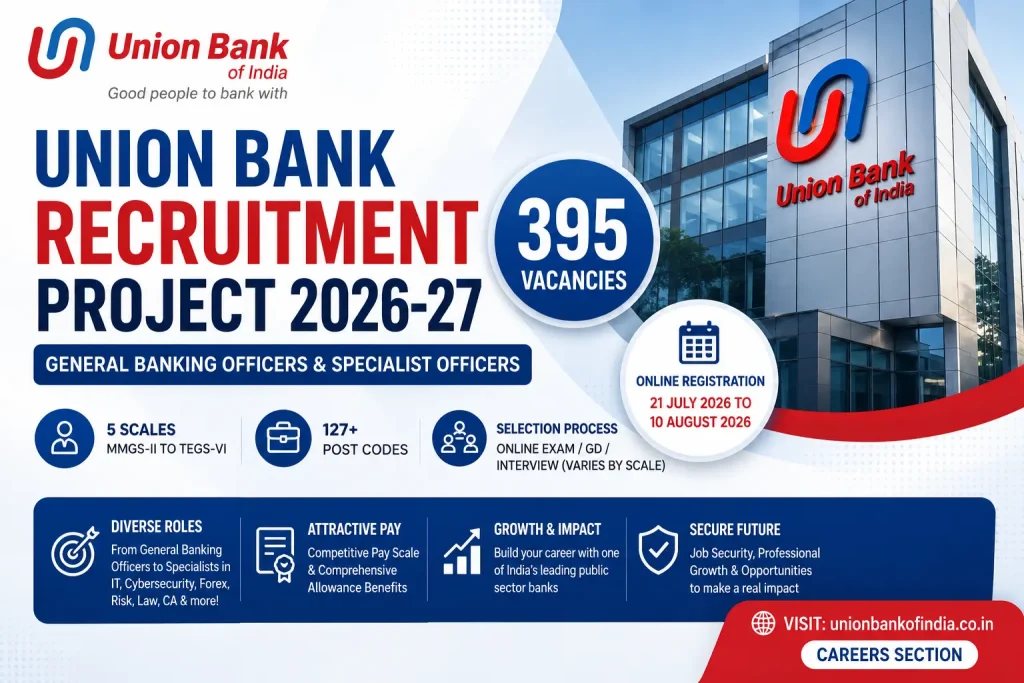
Union Bank of India has opened its much-awaited Recruitment Project 2026-27, inviting applications for 395 vacancies across General Banking Officers and Specialist Officers. This isn’t a small, single-post drive — it spans everything from branch-level credit officers to Deputy General Managers, and covers highly specific technical domains like cybersecurity, GenAI/ML, blockchain, forex, chartered accountancy, law, and even fire safety and architecture.
If you’re a working banking professional, a fresh graduate with the right domain certification, or an experienced technologist looking to move into BFSI, this notification is worth reading carefully — because unlike a typical clerk or PO exam, eligibility here depends heavily on your specific post code, your certifications, and your years of relevant experience.
Latest Update
- Notification released: Union Bank Recruitment Project 2026-27
- Total vacancies: 395 (across 5 scales and roughly 127 distinct post codes)
- Online registration window: 21 July 2026 to 10 August 2026
- Official website: unionbankofindia.co.in (careers section)
Quick Highlights
| Particular | Detail |
|---|---|
| Recruiting Body | Union Bank of India |
| Recruitment Name | Union Bank Recruitment Project 2026-27 |
| Total Vacancies | 395 |
| Post Categories | General Banking Officers + Specialist Officers |
| Scales Covered | MMGS-II to TEGS-VI |
| Application Mode | Online only |
| Selection Process | Online exam and/or GD and/or Interview (varies by scale) |
| Probation Period | 2 years |
What This Recruitment Drive Actually Covers
Union Bank has structured this hiring round around two broad tracks:
General Banking Officers (Post codes G01–G19): These include Fraud Examiners, AML Specialists, Financial Crimes Investigators, Project Management Professionals, Personal Assistants to Executives, general banking/credit officers, and vendor management (non-IT) roles.
Specialist Officers (Post codes S01–S108): This is the bulk of the drive and spans Forex Officers, a huge range of IT and cybersecurity specialists (API management, cloud, DevSecOps, data science, GenAI/ML, network and firewall administration, UI/UX, and more), Chartered Accountants across taxation/credit/balance sheet functions, Risk Management Officers, Law Officers, Architects, Civil and Electrical Engineers, and Fire Officers.
Each post code has its own scale, age limit, qualification, and — for most specialist roles — a mandatory professional certification plus a minimum number of years of directly relevant post-qualification experience. This is not a fresher-friendly exam in the way PO recruitment is; most posts require prior banking or industry experience.
Key Takeaway: Before you shortlist which post to apply for, match your existing certification and experience years against the specific post code — general enthusiasm for banking isn’t enough for most of these roles.
Important Dates
| Event | Date |
|---|---|
| Start of online registration and fee payment | 21 July 2026, 00:00 hrs |
| Last date for online registration and fee payment | 10 August 2026, 23:59 hrs |
| Cut-off date for age eligibility | 1 July 2026 |
| Cut-off date for educational qualification, certification, and experience | 10 August 2026 |
Expert Tip: Union Bank calculates your age eligibility from the first day of the registration month, not the closing date. So even if you turn a year older during the application window, your age is locked in as of 1 July 2026.
Vacancy Breakdown by Scale
| Scale/Grade | Cadre | Vacancies |
|---|---|---|
| MMGS-II | Manager | 163 |
| MMGS-III | Senior Manager | 153 |
| SMGS-IV | Chief Manager | 52 |
| SMGS-V | Assistant General Manager (AGM) | 20 |
| TEGS-VI | Deputy General Manager (DGM) | 7 |
| Total | 395 |
Category-wise, out of 395 total posts: 57 are reserved for SC, 27 for ST, 105 for OBC, 36 for EWS, and 170 are Unreserved. A separate allocation exists for Persons with Benchmark Disabilities across Orthopedic, Hearing, Visual, and Intellectual Disability categories.
Important Note: The number of vacancies is provisional and may change based on the Bank’s actual requirement and the availability of suitable candidates — this is stated explicitly in the notification, so don’t treat these numbers as fixed.
Vacancy Distribution by Domain (Specialist Segment)
To give you a practical sense of where the bulk of specialist hiring is happening:
| Domain Cluster | Approximate Vacancies |
|---|---|
| Forex Officers (Scale II & III) | 50 |
| Chartered Accountants (Credit, Taxation, Balance Sheet, etc.) | 79 |
| Law Officers (Scale II–V) | 30 |
| IT & Cybersecurity specialists (60+ distinct post codes) | ~70 |
| Risk Management Officers | ~15 |
| Architects, Civil/Electrical Engineers, Fire Officers | ~20 |
| General Banking Officers (G15/G16) | 50 |
| Personal Assistants to Executives | 25 |
These are approximate clusters based on the post-code table in the notification; always verify the exact number against your specific post code in the official PDF, since some codes carry just 1 or 2 vacancies.
Download Official Notification PDF
Pay Scale by Cadre
| Cadre | Scale | Approx. Pay Scale | Approx. CTC (Lakhs) |
|---|---|---|---|
| Manager | MMGS-II | 64,820–93,960 | ~21 |
| Senior Manager | MMGS-III | 85,920–1,05,280 | ~25 |
| Chief Manager | SMGS-IV | 1,02,300–1,20,940 | ~30 |
| AGM | SMGS-V | 1,20,940–1,35,020 | ~38 |
| DGM | TEGS-VI | 1,40,500–1,56,500 | ~47 |
On top of basic pay, officers get Special Allowance, Dearness Allowance, and other allowances as per prevailing bank rules, along with perks like residential quarters or lease rent, LFC, and medical reimbursement. Actual CTC will vary by posting location, DA revisions, and applicable schemes.
Eligibility Criteria
Nationality
You must be an Indian citizen, or a subject of Nepal or Bhutan, or a Tibetan refugee who came to India before 1 January 1962 intending to settle permanently, or a person of Indian origin who migrated from Pakistan, Myanmar, Sri Lanka, select East African countries, Zambia, Malawi, Zaire, Ethiopia, or Vietnam with the same intention (subject to a Government of India eligibility certificate where applicable).
Age, Qualification, and Experience — This Varies Enormously by Post
Unlike PO or clerk exams where one age band applies to everyone, here the age limit, qualification, and experience requirement is set individually for each of the roughly 127 post codes. A few representative examples:
- General Banking Officer (Scale II, G16): Age 22–30, Graduate in any discipline, minimum 2 years banking experience including 1 year as Branch Head or Credit Officer.
- Forex Officer (Scale II, S02): Age 22–30, Graduate, minimum 3 years relevant banking experience.
- Cybersecurity & Forensic Analyst (Scale III, S08): Age up to 38 (min 25), B.E./B.Tech in CS/IT/ECE/EEE or MCA/M.Sc, plus a certification such as CISSP, CISM, OSCP, or Azure Security Engineer, with minimum 5 years’ experience including 3 years leading DFIR investigations.
- Chartered Accountant – Credit (Scale IV, S80): Age up to 40, CA/CMA/CFA qualification, minimum 8 years’ experience with 5 years in corporate credit appraisal.
- Law Officer (Scale V, S89): Age up to 45, Bachelor’s degree in law, minimum 15 years combined experience as a practicing advocate and/or Law Officer, including at least 10 years specifically as a Law Officer in a scheduled bank, PSU, or government department.
- Enterprise Architect (Scale VI, S21): Age up to 50, B.E./B.Tech in CS/IT/ECE or MCA plus TOGAF-9 or equivalent certification, minimum 15 years’ experience with at least 8 years in senior leadership.
Important Note: All educational qualifications must be from full-time regular courses at recognized universities — no equivalent qualification will be considered for eligibility, and no clerical-cadre experience counts toward the post-qualification experience requirement.
Given the volume of post codes, the only reliable way to check your eligibility is to look up your exact post code in the official notification PDF rather than relying on a general summary.
Mandatory Certifications
Many specialist roles (especially in IT, cybersecurity, cloud, and data centre management) list one or more acceptable certifications — for example, a Cloud Administrator role accepts VMware VCP-DCV, RHCE, MCSA/MCSE, or equivalent AWS/Azure certifications. Chartered Accountant and Law Officer roles instead require the underlying professional qualification (CA/CMA/CFA, LLB) rather than an additional certification.
Experience Documentation
Only full-time employment with an established employer-employee relationship counts. Appointment letters, salary slips, or pay certificates alone will not be accepted as proof of experience — you need a formal experience certificate in the Bank’s prescribed format (Annexure-II), signed by a competent authority at the Head Office/Controlling Office level of your employer, clearly stating your role, tenure, and duties.
Expert Tip: If you’ve been meaning to request an experience letter from your current or previous employer, start now. Getting the right signatory and the correct format sorted in the last week before the deadline is a common reason candidates get disqualified even after clearing later stages.
Age Relaxation
| Category | Relaxation |
|---|---|
| SC / ST | 5 years |
| OBC (Non-creamy layer) | 3 years |
| Persons with Benchmark Disability (PwBD) | 10 years |
| Ex-Servicemen / ECOs / SSCOs (min. 5 years service) | 5 years |
| Persons affected by 1984 riots | 5 years |
Relaxation for SC/ST/OBC can be combined cumulatively with only one of the other applicable categories (PwBD, Ex-servicemen, or riot-affected). There is no reservation for Ex-servicemen in the officer cadre — the age relaxation is a separate benefit from reservation.
Application Fee
The official notification includes a separate fee schedule by category, which was not fully captured in the portion of the document reviewed for this article. Because getting this number wrong is a common source of application rejection, please verify the exact application fee and payment mode directly on the official notification PDF or the Union Bank careers portal before proceeding — don’t rely on any third-party site’s fee figure without cross-checking.
Selection Process
Union Bank has structured selection differently depending on scale:
For posts up to Scale III (which covers G01–G19 and S01–S108 up to Scale III): the process may include an Online Examination, followed by Group Discussion (if the Bank decides it’s needed) and/or a Personal Interview, depending on how many eligible applicants there are for that post code.
For posts in Scale IV, V, and VI: the process typically skips the written exam and instead may involve Group Discussion and/or another assessment and/or a Personal Interview.
Importantly, the Bank explicitly reserves the right to skip the online exam or GD altogether and call candidates directly for interview, or to modify the selection method for any post at its discretion. So don’t assume every post follows an identical stage-by-stage pattern.
Key Takeaway: Just meeting the eligibility criteria does not guarantee a call for GD or interview — the Bank shortlists based on numbers and merit ranking, not automatically for everyone who applies.
Exam Pattern
Specialist Officer Posts (S01–S108), up to Scale III
| Test | Questions | Marks | Duration |
|---|---|---|---|
| Professional Knowledge (relevant to the post) | 50 | 100 | 60 minutes |
General Banking Officer Posts (G01–G19), up to Scale III
| Test | Questions | Marks | Nature |
|---|---|---|---|
| Quantitative Aptitude | 25 | 25 | Qualifying only |
| Reasoning | 25 | 25 | Qualifying only |
| English Language | 25 | 25 | Qualifying only |
| Professional Knowledge | 50 | 100 | Counts toward merit |
| Total | 125 | 175 | 120 minutes |
For General Banking Officer posts, the Quant, Reasoning, and English sections are purely qualifying — your final merit ranking is based only on your Professional Knowledge score. All sections except English are available in both English and Hindi.
Negative Marking
There is negative marking: 0.25 marks (one-fourth) deducted for every wrong answer. Unattempted questions carry no penalty.
Qualifying Marks
Minimum qualifying marks are 40% for General/EWS candidates and 35% for reserved category candidates (SC/ST/OBC/PwBD) in each section — though the Bank reserves the right to change or waive this at its discretion.
Personal Interview
Where conducted, the interview carries 100 marks, with a qualifying threshold of 50 for General/EWS and 45 for reserved categories. Candidates are typically called for interview in a 1:3 ratio against vacancies, though the Bank may alter this ratio.
Final Merit
Depending on which stages are actually conducted for your post, the final merit list is built either from Online Exam + Interview marks combined, from Interview marks alone, or from GD/other assessment + Interview marks combined — all category-wise, in descending order.
Probation and Service Bond
Selected candidates serve a 2-year probation period from the date of joining. There’s also a Service Indemnity Bond: candidates selected for General Banking posts (G01–G19) commit to serving a minimum of 3 years or paying ₹2,00,000 plus applicable taxes if they leave early; for Specialist posts (S01–S108), the bond amount is ₹2,50,000 plus applicable taxes.
How to Apply Online — General Steps
- Visit the official Union Bank of India careers page and locate the Recruitment Project 2026-27 link.
- Register with a valid email ID and mobile number to generate your provisional registration number and password.
- Fill in personal, educational, certification, and experience details carefully — remember, no category change is allowed after submission.
- Upload scanned photograph and signature as per the specifications in the notification’s Annexure-I.
- Upload your experience certificate(s) in the Bank’s prescribed format where applicable.
- Pay the application fee/intimation charges online.
- Review the complete form before final submission — you cannot edit it afterward.
- Save and print the final application and fee payment confirmation for your records.
Important Note: You can apply for only one post. If you submit multiple applications, only the last complete one is considered valid, and multiple appearances for the same post in an interview will result in cancellation of your candidature.
Documents You’ll Likely Need
- Recent passport-size photograph and signature (scanned as per specification)
- Proof of date of birth
- Educational qualification certificates and mark sheets
- Mandatory professional certification proof (where applicable to your post)
- Experience certificate(s) in the Bank’s prescribed Annexure-II format
- Category certificate (SC/ST/OBC-non-creamy layer/EWS), if applicable
- PwBD certificate from a competent authority, if claiming disability reservation
- Valid photo ID proof matching the name on your application
- Ex-servicemen discharge certificate, if applicable
Common Mistakes Candidates Make While Applying
- Applying for a post code without checking the exact age, qualification, and experience match.
- Submitting appointment letters or salary slips instead of a proper experience certificate.
- Missing the difference between the age cut-off (1 July 2026) and the qualification/experience cut-off (10 August 2026).
- Applying for more than one post, which invalidates all but the last submission.
- Selecting the wrong category and assuming it can be corrected later — it cannot.
- Ignoring the mandatory certification requirement for IT and specialist roles.
- Not keeping a printed copy of the submitted application and fee receipt.
- Uploading photographs or signatures that don’t meet the specified format, leading to rejection at document verification.
- Assuming a written exam will be conducted for every post, when higher scales may go straight to interview.
- Waiting until the last day to pay fees or register, risking last-minute technical issues.
Why Consider Union Bank of India?
Union Bank is one of India’s major Public Sector Banks with pan-India and overseas presence. Beyond the pay scale, officers get PSU-standard job security, structured promotion pathways, allowances for housing and medical costs, LFC benefits, and — particularly relevant here — the opportunity to work in specialized, modern domains like GenAI/ML, cybersecurity, and open banking within a public sector banking environment, which is a fairly unique combination in India’s job market right now.
Frequently Asked Questions
1. How many total vacancies are in Union Bank SO Recruitment 2026? 395 vacancies across General Banking Officer and Specialist Officer posts.
2. What is the last date to apply? 10 August 2026, 23:59 hrs.
3. Is there negative marking in the exam? Yes, 0.25 marks are deducted for each wrong answer.
4. What is the application fee? The fee schedule is given in the official notification; verify it directly there before applying, as it varies by category.
5. Can I apply for more than one post? No. Only one application is allowed; if you submit multiple, only your last complete submission is considered.
6. What is the age cut-off date? 1 July 2026, the first day of the month in which registration opens.
7. Is a written exam compulsory for all posts? No. For posts up to Scale III it typically includes a written exam, but for Scale IV, V, and VI posts, selection may go through GD/assessment and interview without a written test, and the Bank can also call candidates directly for interview.
8. What is the qualifying mark in the online exam? 40% for General/EWS candidates and 35% for reserved category candidates in each section.
9. Are the Quant, Reasoning, and English sections counted for merit in the General Banking Officer exam? No, they are qualifying only. Only the Professional Knowledge section counts toward merit.
10. What documents are accepted as proof of experience? Only a formal experience certificate in the Bank’s prescribed Annexure-II format, signed by a competent authority. Appointment letters, salary certificates, or pay slips are not accepted.
11. Is there reservation for Ex-servicemen in this recruitment? No reservation, but a 5-year age relaxation is available for eligible Ex-servicemen/ECOs/SSCOs.
12. What is the probation period after selection? 2 years from the date of joining.
13. Is there a service bond? Yes — ₹2,00,000 for General Banking posts and ₹2,50,000 for Specialist Officer posts if you leave before completing 3 years of service.
14. Can OBC candidates under the creamy layer avail reservation? No. Creamy layer OBC candidates must apply under the Unreserved category.
15. What is the minimum qualifying mark in the interview? 50 marks for General/EWS and 45 marks for reserved categories, out of 100.
16. In what ratio are candidates called for interview? Generally 1:3 against the number of vacancies, though the Bank may change this.
17. Can I change my category after submitting the application? No, category changes are not permitted after registration.
18. Are compensatory time and scribe facilities available for PwBD candidates? Yes, as per detailed guidelines in the notification, including 20 minutes per hour of compensatory time in most cases.
19. Does clerical-cadre banking experience count toward eligibility? No, clerical experience is explicitly excluded from post-qualification experience calculations.
20. Where can I check post-specific eligibility in detail? In the official Union Bank Recruitment Project 2026-27 notification PDF, under the post-code-wise eligibility tables.
Final Word
This is one of the largest and most technically diverse specialist recruitment drives Union Bank has run in recent years — the sheer range of post codes means it rewards careful, specific preparation over generic exam prep. If you already hold a relevant certification and years of matching experience, this is a real opportunity to move into a stable, well-compensated PSU role. Because vacancy numbers, fee structures, and process details can be revised through corrigenda, keep checking the official Union Bank of India website regularly right up to the application deadline.
Related Reads

Karmasetu is a dedicated team of government job researchers and exam
enthusiasts based in West Bengal. With a combined experience of tracking
central and state government recruitments across India, the team covers
SSC, Railway, Banking, Defence, and State PSC notifications — verified
directly from official sources.
Our goal is simple: give every job seeker in India accurate, timely,
and easy-to-understand recruitment information so they never miss an
opportunity. Every article on Karmasetu is written after reading the
official notification PDF, cross-checked for eligibility details, and
updated whenever official changes are announced.
Follow us on Telegram (@karmasetu) for instant job alerts.
