

If you’ve just started preparing for IBPS Clerk 2026, the first thing that decides how well your preparation goes is not the number of hours you put in — it’s whether you’re studying the right topics in the right order. Thousands of aspirants waste months solving random question banks without ever mapping their effort to what the exam actually rewards. This guide fixes that. We’ve broken down the complete IBPS Clerk syllabus and exam pattern for Prelims and Mains, section by section, along with study plans, book recommendations, and the mistakes that quietly cost candidates their selection every year.
Latest Update Box
- The IBPS Clerk 2026 notification for CRP CSA-XVI is expected around July–August 2026, with Prelims likely in September–October and Mains around November–December 2026.
- The Mains exam pattern has been revised in recent cycles — the question count has come down from the older 190-question format to a leaner 155-question paper, and total Mains duration has been trimmed to 120 minutes.
- The standalone “Computer Aptitude” section has been folded into “Reasoning Ability,” so computer-related questions now appear within the reasoning paper instead of as a separate section.
- Different sources are currently reporting slightly different section-wise splits for the revised Mains pattern. We’ve flagged this clearly below — always cross-check the final split against the official IBPS notification once it drops.
- Selection continues to be a two-stage written process (Prelims + Mains) with no interview, followed by a qualifying Language Proficiency Test (LPT) for candidates who haven’t studied the regional language up to Class 10.
Featured Snippet: What is IBPS Clerk Syllabus?
The IBPS Clerk syllabus covers Reasoning Ability, Quantitative Aptitude (Numerical Ability), and English Language for the Prelims exam, and adds General/Financial Awareness to the same core subjects for the Mains exam, with computer knowledge tested within the Reasoning section.
Featured Snippet: What is IBPS Clerk Exam Pattern?
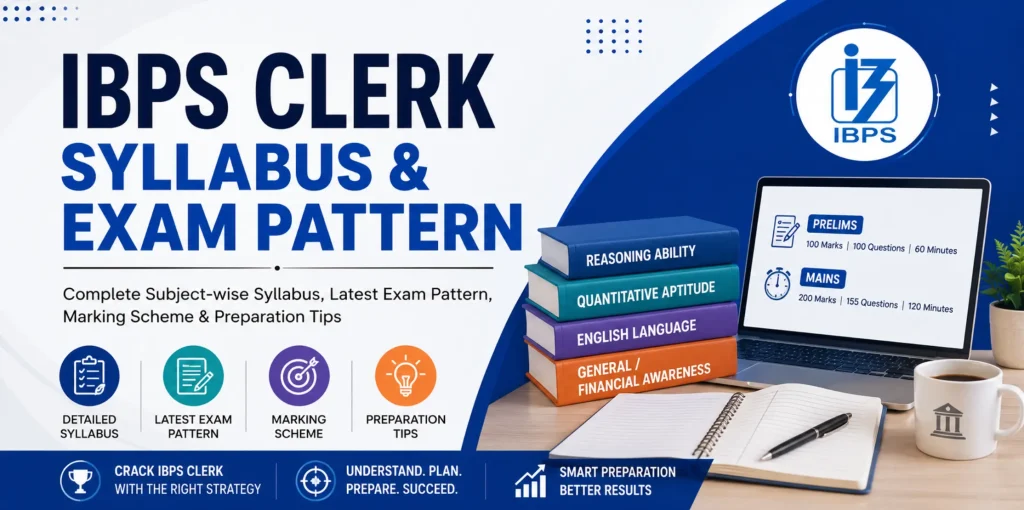
IBPS Clerk selection happens in two online, objective-type stages — Prelims (100 marks, 100 questions, 60 minutes) and Mains (200 marks, 155 questions, 120 minutes) — with sectional timing in both stages and no interview.
Featured Snippet: Is there negative marking?
Yes. Both Prelims and Mains carry a negative marking of 0.25 marks for every wrong answer, while unattempted questions carry no penalty.
Featured Snippet: How many stages are there?
There are three stages in total: Prelims (qualifying), Mains (merit-deciding), and a Language Proficiency Test (qualifying, conducted after provisional allotment).
Quick Highlights Table
| Particulars | Details |
|---|---|
| Conducting Body | Institute of Banking Personnel Selection (IBPS) |
| Exam Name | Common Recruitment Process for Clerks (CRP CSA) |
| Post | Customer Service Associate (Clerk) |
| Selection Stages | Prelims → Mains → Language Proficiency Test |
| Interview | Not applicable |
| Prelims Marks / Duration | 100 marks / 60 minutes |
| Mains Marks / Duration | 200 marks / 120 minutes |
| Negative Marking | 0.25 marks per wrong answer |
| Mode of Exam | Online, Computer-Based Test |
| Medium | English and Hindi (except English Language section) |
| Final Merit | Based only on Mains score |
What is IBPS Clerk Exam?
IBPS Clerk is the recruitment process run by the Institute of Banking Personnel Selection to fill Customer Service Associate posts in participating public sector banks across India. It’s one of the highest-volume banking exams in the country, drawing lakhs of graduate applicants every year for a set of vacancies that typically runs into several thousand. Unlike some other government exams, there’s no interview stage here — your Mains score alone decides whether you get selected, which makes the written exam the single most important hurdle in your entire journey.
Because the competition is enormous and the seats are limited, small differences in preparation strategy end up creating large differences in outcome. Someone who understands exactly what to study, in what order, and how much time to give each topic consistently outperforms someone who is simply “solving a lot of questions” without direction.
Expert Tip
Don’t start your IBPS Clerk prep by jumping straight into mock tests. Spend your first two weeks purely on understanding the syllabus and exam pattern in depth — it saves months of misdirected effort later.
IBPS Clerk Selection Process
The selection process has three parts, though only two of them are actual exams:
- Preliminary Examination – A qualifying-stage screening test. Marks scored here are not added to your final merit; you just need to clear the sectional and overall cut-offs to move ahead.
- Main Examination – This is where your actual selection happens. Your Mains score is the sole basis for the final merit list and provisional allotment.
- Language Proficiency Test (LPT) – A qualifying test conducted after Mains (usually around the time of provisional allotment) to confirm you can read, write, and converse in the official language of the state you’ve applied for. If you studied that language up to Class 10 or above, you’re generally exempted on submission of proof. Skipping this step or failing it can disqualify you even after clearing Mains, so don’t treat it as an afterthought.
Key Takeaways
- Prelims is a gatekeeper, not a scorer — your Mains marks are what matter for the final list.
- There’s no interview, so your entire evaluation happens through two written papers.
- The LPT is easy to forget but can end your candidature if ignored — start checking your eligibility for exemption early.
Before you dive into the exam pattern, it’s worth knowing what all this preparation is actually working toward — check out our detailed IBPS Clerk Salary breakdown to see the pay scale, allowances, and career growth that come with clearing this exam.
IBPS Clerk Exam Pattern 2026 Overview
Both stages are conducted online in multiple shifts, and since difficulty can vary slightly between shifts, IBPS applies a normalisation process to make scores comparable across all candidates. Both Prelims and Mains are objective, multiple-choice tests, both carry sectional time limits (you cannot borrow time from one section to finish another), and both apply the same 0.25 negative marking rule for incorrect answers.
The core structural difference is this: Prelims has three sections and is purely a screening round, while Mains has four sections, carries double the marks of Prelims, and is the exam that actually decides your fate.
IBPS Clerk Prelims Exam Pattern
| Subject | Questions | Marks | Duration |
|---|---|---|---|
| English Language | 30 | 30 | 20 minutes |
| Numerical Ability (Quant) | 35 | 35 | 20 minutes |
| Reasoning Ability | 35 | 35 | 20 minutes |
| Total | 100 | 100 | 60 minutes |
Sectional timing: Each of the three sections has its own fixed 20-minute window. You attempt them one after another, and once a section’s time is up, you cannot go back to it — even if you finish another section early, that spare time doesn’t carry over.
Negative marking: 0.25 marks are deducted for every wrong answer. Unattempted questions carry no penalty, so a blind guess only makes sense when you can eliminate at least two of the four options.
Difficulty level: Prelims is generally rated easy to moderate. English tends to be the most time-pressured section for many candidates because vocabulary-heavy questions can eat into your 20 minutes quickly. Numerical Ability leans toward calculation speed, while Reasoning is largely about pattern recognition under a clock.
Common mistakes: The biggest one is spending too long on a single tricky question and letting the sectional timer run out before attempting easier questions later in that same section. The second common mistake is neglecting English because “it’s just 30 marks” — but a poor English score can single-handedly push you below the sectional cut-off even if your overall score looks fine.
Expert Tip
In Prelims, accuracy beats ambition. Attempting 70 questions with 90% accuracy will almost always beat attempting 90 questions with 60% accuracy, because every wrong answer eats into your score twice — once for the marks you didn’t get, and once for the 0.25 you lose.
IBPS Clerk Mains Exam Pattern
The Mains paper has gone through a genuine revision recently, and you must prepare from the updated structure rather than the older 190-question format that’s still floating around in outdated PDFs and old mock test series.
| Subject | Questions (approx.) | Marks | Duration |
|---|---|---|---|
| General / Financial Awareness | 40 | 40 | 20 minutes |
| General English | 40 | 40 | 35 minutes |
| Reasoning Ability (incl. Computer Knowledge) | 45 | 60 | 35 minutes |
| Quantitative Aptitude | 30 | 60 | 30 minutes |
| Total | 155 | 200 | 120 minutes |
Important note on figures: Different coaching platforms are currently reporting slightly different section-wise question splits for the revised Mains pattern — some list Quantitative Aptitude at 35 questions, others at 30; some list Reasoning at 60 questions, others lower. What’s consistently confirmed across sources is the total: 155 questions, 200 marks, and 120 minutes overall. Marks per question are not uniform across sections (Reasoning and Quant typically carry more weight per question than English or General Awareness), which is standard IBPS practice. Treat the table above as a well-corroborated working structure for your preparation, but download and cross-check the official notification PDF the day it releases before finalising your section-wise time allocation strategy.
Sectional timing: Just like Prelims, each Mains section has its own dedicated time block, and you can’t shift time between sections.
Negative marking: Same 0.25 deduction per wrong answer applies here too, and given that Mains marks decide your entire selection, careless guessing here is far costlier than in Prelims.
Difficulty: Mains is a clear step up from Prelims. Puzzles get more layered, Data Interpretation sets involve heavier calculation, General Awareness questions go deeper into recent banking and financial developments, and the English section tests comprehension and grammar at a more advanced level.
Scoring opportunities: General Awareness is often the section where well-prepared candidates gain the biggest edge over the average aspirant, simply because most people under-prepare it until the last month. If you build a consistent daily reading habit early, this section alone can lift your overall Mains score meaningfully.
Key Takeaways
- Mains carries double the marks of Prelims and is the only stage that counts toward selection.
- The pattern has been trimmed down — fewer questions, shorter overall duration, so speed matters as much as accuracy now.
- General Awareness rewards early, consistent preparation far more than last-minute cramming.
Difference Between Prelims and Mains
| Parameter | Prelims | Mains |
|---|---|---|
| Nature | Qualifying only | Merit-deciding |
| Sections | 3 | 4 |
| Total Marks | 100 | 200 |
| Total Questions | 100 | 155 (approx.) |
| Duration | 60 minutes | 120 minutes |
| Extra Subject | — | General/Financial Awareness |
| Difficulty | Easy to moderate | Moderate to difficult |
| Counted in Final Merit | No | Yes |
IBPS Clerk Prelims Syllabus
| Subject | Important Topics | Difficulty | Preparation Priority |
|---|---|---|---|
| Reasoning Ability | Puzzles, Seating Arrangement, Syllogism, Blood Relation, Coding-Decoding | Moderate | High |
| Quantitative Aptitude | Simplification, Number Series, Data Interpretation, Quadratic Equations | Moderate | High |
| English Language | Reading Comprehension, Cloze Test, Error Detection, Para Jumble | Moderate | High |
Reasoning Ability
Reasoning is the subject that separates well-prepared candidates from average ones because it’s less about knowledge and more about trained thinking. IBPS uses it to check how quickly and accurately you can decode logical structures under time pressure — a skill that matters directly in day-to-day banking operations where accuracy under time constraints is non-negotiable.
Puzzle: This covers box puzzles, floor-based puzzles, scheduling puzzles and more, where you place multiple variables against multiple conditions simultaneously. IBPS asks this because it’s the single best test of sustained logical consistency — one wrong deduction early on collapses the entire puzzle. Beginners usually make the mistake of trying to solve puzzles purely in their head instead of drawing a clean table, which leads to silly errors. The fix is simple: always draw the structure first, fill in certain information before probable information, and revisit uncertain slots only after everything definite is placed.
Seating Arrangement: Circular, linear, and rectangular arrangement questions test the same core skill as puzzles but with a spatial twist. The common beginner mistake is not marking “facing inside” versus “facing outside” clearly, which flips every relative direction in the question. Practising with a consistent notation system from day one avoids this entirely.
Blood Relation: These test your ability to track family trees from scattered statements. IBPS includes it because it rewards careful reading over shortcuts. Beginners often assume a relationship instead of building the family tree step by step — draw it out every single time, even when you think you can solve it mentally.
Coding-Decoding: This checks pattern recognition — letters shifting by a fixed number, words coded through a substitution logic, and so on. The biggest beginner error is trying to memorise old years’ coding patterns instead of understanding the underlying logic, which fails the moment IBPS changes the coding style.
Syllogism: Statements and conclusions based on formal logic. Candidates often fall into the trap of using real-world knowledge instead of pure logical rules — remember, in syllogism, you only work with what’s stated, never with what’s realistically true.
Direction: Distance and direction-based questions test spatial reasoning. Draw a rough diagram every time rather than tracking movements mentally; it’s faster in practice, not slower.
Alphabet & Ranking: These tests quick alphabet-position recall and comparative ranking logic. Regular practice with alphabet position charts builds the recall speed IBPS is testing for.
Inequality: Coded or direct inequality statements test your ability to combine multiple relational statements into a single valid conclusion. Beginners often skip the “either-or” case, which is where most marks are actually lost.
Input-Output: A step-by-step word/number rearrangement logic. IBPS asks this to test whether you can track a multi-step process without losing your place — write out each step rather than jumping ahead.
Data Sufficiency: More common in Mains than Prelims, this test tests whether you truly understand a concept or are just pattern-matching, since you have to judge whether the given data is enough to answer a question, not actually solve it fully.
Expert Tip
Reasoning rewards structured practice more than volume. Solving 10 puzzles with a proper table-drawing method beats solving 30 puzzles carelessly in your head.
Quantitative Aptitude
Quant tests your calculation speed and conceptual clarity, both of which matter directly for a banking role that involves handling numbers daily.
Simplification & Approximation: Basic arithmetic operations under time pressure. These should be your fastest-scoring questions if your BODMAS and calculation shortcuts are solid — beginners lose time here by not memorising squares, cubes, and tables up to a reasonable range.
Data Interpretation (DI): Tables, bar graphs, pie charts, and line graphs test your ability to extract and calculate from visual data. IBPS values this heavily because it mirrors real banking analysis work. The common mistake is misreading the graph’s scale or units — always double-check the axis and units before calculating.
Quadratic Equations: A quick comparison-based topic once you know the standard solving methods. Beginners waste time using the full formula method instead of factorisation shortcuts.
Number Series: Pattern-based series completion. Practice recognising common series types (difference-based, ratio-based, mixed) so you can identify the pattern within seconds rather than minutes.
Arithmetic Topics (Profit & Loss, SI/CI, Ratio, Average, Time & Work, Boat & Stream, Partnership, Mensuration, Geometry, Probability): These form the bulk of both Prelims and Mains Quant. Each has standard formula-based shortcuts, and the biggest beginner mistake across all of them is trying to solve everything from first principles during the exam instead of having formulas at instant recall.
Expert Tip
Build a personal formula sheet for every arithmetic topic and revise it weekly. Quant scores go up not from learning new concepts closer to the exam, but from making old concepts instant to recall.
English Language
English is where most non-English-medium candidates lose easy marks, not because the questions are hard, but because vocabulary and grammar rules aren’t revised consistently.
Reading Comprehension: Passage-based questions testing comprehension, inference, and vocabulary-in-context. IBPS gives this high weightage because reading speed and comprehension directly affect how efficiently a bank employee processes written communication. Beginners often read the passage too slowly — practice skimming for structure first, then reading in detail for the specific question types asked.
Cloze Test: Fill-in-the-blank passages testing contextual vocabulary and grammar together. The mistake to avoid is picking a grammatically correct word that doesn’t fit the passage’s context — always read the full sentence, not just the blank.
Error Detection & Sentence Improvement: Grammar-focused questions. These reward candidates who’ve built strong fundamentals in tenses, subject-verb agreement, and parallelism rather than those relying purely on “it sounds wrong” instinct.
Para Jumble: Sentence reordering questions that test logical flow. Look for the opening sentence (usually the most general statement) and closing sentence (usually the conclusion) first, then work the middle sentences around them.
Fillers, Vocabulary, Word Swap, Phrase Replacement: These test applied vocabulary rather than rote word lists. Reading editorial-style English content daily (not just word lists) builds this skill far more effectively than memorising word meanings in isolation.
Expert Tip
Read one editorial article daily and note down five unfamiliar words with their contextual meaning. Over three months, this builds vocabulary that mock test word-lists simply can’t replicate.
If you’re also exploring other clerical banking exams alongside this one, check out our SBI Clerk Salary and SBI Clerk Syllabus guides to see how the pay structure and exam syllabus compare with IBPS Clerk.
IBPS Clerk Mains Syllabus
| Section | Core Focus |
|---|---|
| Reasoning & Computer Knowledge | Advanced puzzles, seating arrangement, and basic computer fundamentals |
| General/Financial Awareness | Current affairs, banking awareness, static GK, financial terms |
| English Language | Advanced comprehension, grammar, professional vocabulary |
| Quantitative Aptitude | Advanced DI, arithmetic, data sufficiency |
Reasoning & Computer: Mains reasoning builds on the same Prelims topics but at a noticeably harder level — longer puzzles, more layered conditions, and trickier inequality and input-output sets. Computer knowledge questions (basic hardware/software concepts, MS Office fundamentals, internet and networking basics, shortcut keys, and banking-relevant computer terms) are now tested within this same section rather than as a standalone paper.
General/Financial Awareness: This is the section that rewards daily habit over last-minute cramming. Expect questions from the last six months of banking and financial current affairs, RBI policies and monetary tools, government schemes, important committees, awards, books and authors, and static banking awareness (types of accounts, negotiable instruments, banking terminology). Because the sectional time has reportedly been trimmed in the revised pattern, quick recall matters more than ever — you don’t have time to “think through” a GK question.
English Language: The Mains English section pushes comprehension and grammar into more professional, formal-register content compared to Prelims, along with slightly denser passages.
Quantitative Aptitude: Mains Quant carries the same core topics as Prelims but with heavier DI sets (often involving two data sets combined, or caselet-based DI) and more calculation-intensive arithmetic problems.
Key Takeaways
- Mains syllabus is Prelims syllabus plus General/Financial Awareness, with everything tested at a tougher level.
- Computer Knowledge is now embedded within Reasoning rather than being a separate paper.
- General Awareness needs months of daily reading — it cannot be crammed in the final week.
High Weightage Topics
| Subject | Topic | Importance | Reason |
|---|---|---|---|
| Reasoning | Puzzle & Seating Arrangement | Very High | Carries the largest chunk of reasoning marks in both stages |
| Quant | Data Interpretation | Very High | Consistently 10+ marks across recent papers |
| English | Reading Comprehension | High | Largest single block within English |
| Reasoning | Syllogism & Inequality | High | Quick-scoring if concepts are clear |
| GA (Mains) | Banking & Current Affairs (last 6 months) | Very High | Directly tied to recency of preparation |
| Quant | Arithmetic Word Problems | High | Spread across multiple sub-topics, high cumulative weight |
Difficulty Analysis
Easy topics: Simplification/Approximation, basic Number Series, Blood Relation, Direction Sense, Ranking — these should be your fastest, most accurate zone in both stages.
Moderate topics: Reading Comprehension, Data Interpretation, Coding-Decoding, standard arithmetic problems, Cloze Test — solid preparation converts these into scoring topics rather than time-drains.
Most difficult topics: Complex/linked puzzles, caselet-based DI, higher-level Data Sufficiency, and General Awareness questions on niche recent events — these are where toppers separate themselves from the average candidate through sheer consistency of practice and revision.
Expert Tip
Don’t chase the hardest topics first. Master the easy and moderate categories until they’re near-perfect, because that’s where most of your actual score comes from — the difficult topics are bonus marks, not your foundation.
90-Day Study Plan
| Phase | Days | Focus |
|---|---|---|
| Phase 1 | 1–30 | Build concepts across Reasoning, Quant, and English fundamentals; daily GA reading habit starts |
| Phase 2 | 31–60 | Topic-wise practice sets, sectional tests, start Mains-level difficulty |
| Phase 3 | 61–80 | Full-length mock tests (Prelims + Mains pattern), error analysis |
| Phase 4 | 81–90 | Revision, previous year papers, speed drills, light practice only |
60-Day Study Plan
| Phase | Days | Focus |
|---|---|---|
| Phase 1 | 1–20 | Rapid concept revision, focus on high-weightage topics first |
| Phase 2 | 21–45 | Sectional and full-length mocks, targeted weak-area practice |
| Phase 3 | 46–60 | Previous year papers, revision notes, timed speed drills |
30-Day Revision Plan
| Week | Focus |
|---|---|
| Week 1 | Full syllabus revision using formula sheets and short notes |
| Week 2 | Daily full-length mock + detailed error analysis |
| Week 3 | Weak-topic targeted practice, GA current affairs consolidation |
| Week 4 | Light mocks, previous year papers, rest and confidence building |
Daily Study Timetable
| Aspirant Type | Suggested Daily Study Time | Sample Split |
|---|---|---|
| College Student | 2–3 hours | 1 hr Quant/Reasoning, 45 min English, 30 min GA reading, 30 min mock analysis |
| Working Professional | 2–2.5 hours (mornings/evenings) | 45 min Quant, 45 min Reasoning, 30 min GA, remaining for English/revision |
| Full-Time Aspirant | 6–8 hours | Split evenly across all four subjects with one full mock every 2–3 days plus dedicated error analysis time |
Expert Tip
Consistency beats intensity. Two focused hours daily for three months will outperform sporadic eight-hour days followed by burnout.
Preparation Strategy
Beginner: Start with NCERT-level Maths and basic English grammar if your fundamentals are shaky. Don’t attempt full mocks yet — build topic-wise accuracy first.
Intermediate: Move into sectional tests and previous year papers. Start tracking your accuracy percentage per topic, not just your overall score, so you know exactly where to focus next.
Advanced: Shift almost entirely to full-length, timed mock tests under exam conditions. At this stage, the goal is speed optimisation and eliminating silly errors, not learning new concepts.
Common Mistakes
Aspirants repeatedly fall into a handful of avoidable traps: ignoring English until it’s too late because it “feels easy,” treating General Awareness as a last-month subject instead of a daily habit, solving puzzles mentally instead of on paper, guessing randomly under time pressure and losing marks to negative marking, and relying on outdated Mains pattern PDFs without checking the latest official structure. Each of these is fixable simply by being aware of it early in your preparation.
Best Books
| Book | Subject | Best For |
|---|---|---|
| Quantitative Aptitude for Competitive Examinations – R.S. Aggarwal (Buy Now) | Quantitative Aptitude | Concept building and formula practice |
| A Modern Approach to Verbal & Non-Verbal Reasoning – R.S. Aggarwal (Buy Now) | Reasoning Ability | Topic-wise reasoning practice |
| Objective General English – S.P. Bakshi (Buy Now) | English Language | Grammar and vocabulary fundamentals |
| Word Power Made Easy – Norman Lewis (Buy Now) | English Language | Long-term vocabulary building |
| Banking Awareness Handbook (any updated edition) (Buy Now) | General/Financial Awareness | Static banking concepts and terminology |
Best Online Mock Tests
A good mock test series matters as much as your books do, because it’s the only way to genuinely simulate exam-day pressure and sectional timing. Oliveboard, PracticeMock, Guidely, and Smartkeeda are among the widely used platforms for IBPS Clerk mock tests, each offering full-length tests, sectional practice, and detailed performance analytics. If you’re searching for an Oliveboard coupon code, PracticeMock coupon code, Guidely coupon code, or Smartkeeda coupon code before buying a test series, it’s worth comparing the latest offers on Karmasetu.in first — pricing and validity periods change fairly often, and a quick check can save you a meaningful amount.
Mock Test Coupon Comparison
| Platform | Coupon Code | Discount |
|---|---|---|
| Oliveboard | CEOB20 | Maximum discount |
| PracticeMock | COUPONEDGE | 69% off |
| Guidely | CEDGE12 | Extra 12% off |
| Smartkeeda | COUPONEDGE | Maximum discount |
Previous Year Paper Strategy
Solving previous year papers isn’t about memorising questions — IBPS rarely repeats them directly. What they reveal instead is the pattern of difficulty, the typical distribution of easy versus tough questions within a section, and the kind of language IBPS uses to frame its questions. Solve at least the last three to four years’ papers under strict timing, then review every wrong answer to understand whether it was a concept gap, a silly error, or a time-management issue.
Expected Difficulty
Based on recent exam trends (not official IBPS communication), Prelims difficulty has generally stayed in the easy-to-moderate range, while Mains has trended toward slightly denser puzzles and more calculation-heavy DI sets in recent cycles. This is a preparation trend observation, not a guarantee — treat it as a planning input, not a fixed expectation.
Expert Preparation Tips
Build your preparation around three habits: daily practice across all subjects rather than single-subject days, weekly full mocks once your syllabus coverage crosses the halfway mark, and a strict error log where you note down every mistake and revisit it weekly. Candidates who maintain this kind of structured feedback loop consistently outperform those who simply solve question after question without reviewing why they went wrong.
Expert Tip
Treat every mock test’s post-analysis as more valuable than the mock itself. The test tells you your score; the analysis tells you how to improve it.
Frequently Asked Questions
It covers Reasoning Ability, Quantitative Aptitude, and English Language for Prelims, with General/Financial Awareness added for Mains, and computer knowledge tested within the Reasoning section in Mains.
Prelims is 100 marks/100 questions in 60 minutes across three sections; Mains is 200 marks across four sections in 120 minutes, with sectional timing in both stages.
Yes, 0.25 marks are deducted for every wrong answer in both Prelims and Mains, with no penalty for unattempted questions.
Yes, Prelims marks are not counted toward the final merit; you only need to clear the cut-offs to proceed to Mains.
Entirely based on your Mains score — Prelims marks play no role in the final ranking.
No, there is no interview. Selection is purely through Prelims, Mains, and a qualifying Language Proficiency Test.
A qualifying test, usually held after Mains/provisional allotment, that checks your command of the official regional language of the state you’ve applied for. Candidates who studied that language up to Class 10 are generally exempted.
Recent reports put the revised Mains paper at 155 questions for 200 marks, though exact section-wise splits vary slightly by source — verify against the official notification once released.
It hasn’t been removed entirely — computer knowledge questions are now integrated within the Reasoning Ability section instead of appearing as a separate paper.
Each of the three Prelims sections has a fixed 20-minute window that cannot be extended using time saved from another section.
Puzzles and Seating Arrangement consistently carry the largest share of marks in both Prelims and Mains.
Data Interpretation and core arithmetic word problems (Profit & Loss, SI/CI, Time & Work, Ratio) together account for the bulk of Quant marks.
Start with concept-building in Quant and Reasoning, strengthen basic English grammar, and build a daily current affairs reading habit from day one.
It can be, if you follow a structured plan with consistent daily practice and prioritise high-weightage topics — but starting with weak fundamentals in a compressed timeline is genuinely challenging.
Very important — it’s a high-scoring opportunity because most candidates underprepare for it, and it requires no calculation — just consistent daily reading.
Start with sectional tests to build topic-wise accuracy, then move to full-length mocks once your syllabus coverage is reasonably complete.
The exam is bilingual in English and Hindi (and regional language options where applicable), except for the English Language section, which is tested only in English.
Since the exam is conducted across multiple shifts with potentially varying levels of difficulty, IBPS applies a normalisation formula to adjust scores so that all candidates are compared fairly.
The official syllabus PDF is released along with the detailed notification on the IBPS official website; until then, rely on well-corroborated unofficial breakdowns like this one for your planning.
Conclusion
The IBPS Clerk exam rewards structure over sheer effort. Candidates who understand exactly which topics carry weight, build daily habits around General Awareness and vocabulary, and treat mock tests as diagnostic tools rather than just practice runs are the ones who consistently clear both stages. The syllabus itself hasn’t changed dramatically, but the exam has gotten sharper on time — which means your preparation needs to get sharper too. Start early, revise consistently, and trust a plan instead of chasing every new question bank you come across. You have everything you need in this guide to build that plan today.
Related Reading on Karmasetu.in:
- IBPS Clerk Notification 2026
- IBPS Clerk Eligibility Criteria
- IBPS Clerk Salary 2026
- IBPS Clerk Preparation Strategy
- IBPS Clerk Previous Year Papers
- Best IBPS Clerk Mock Test Series
- Oliveboard Coupon Code
- PracticeMock Coupon Code

Karmasetu is a dedicated team of government job researchers and exam
enthusiasts based in West Bengal. With a combined experience of tracking
central and state government recruitments across India, the team covers
SSC, Railway, Banking, Defence, and State PSC notifications — verified
directly from official sources.
Our goal is simple: give every job seeker in India accurate, timely,
and easy-to-understand recruitment information so they never miss an
opportunity. Every article on Karmasetu is written after reading the
official notification PDF, cross-checked for eligibility details, and
updated whenever official changes are announced.
Follow us on Telegram (@karmasetu) for instant job alerts.
