

If you have started your search for the SBI Clerk Syllabus 2026, you are probably feeling a mix of excitement and confusion right now. That’s normal. SBI Clerk is one of the most sought-after banking jobs in India, and lakhs of aspirants apply for it every year. But most students waste their first month just trying to figure out “what to study” instead of actually studying.
This guide fixes that problem completely.
Here, you will find the full SBI Clerk Exam Pattern 2026, the detailed subject-wise syllabus for both Prelims and Mains, the marking scheme, topic-wise weightage, and a preparation plan that actually works — whether you are a college student, a working professional, or someone starting from zero.
Let’s get straight into it.
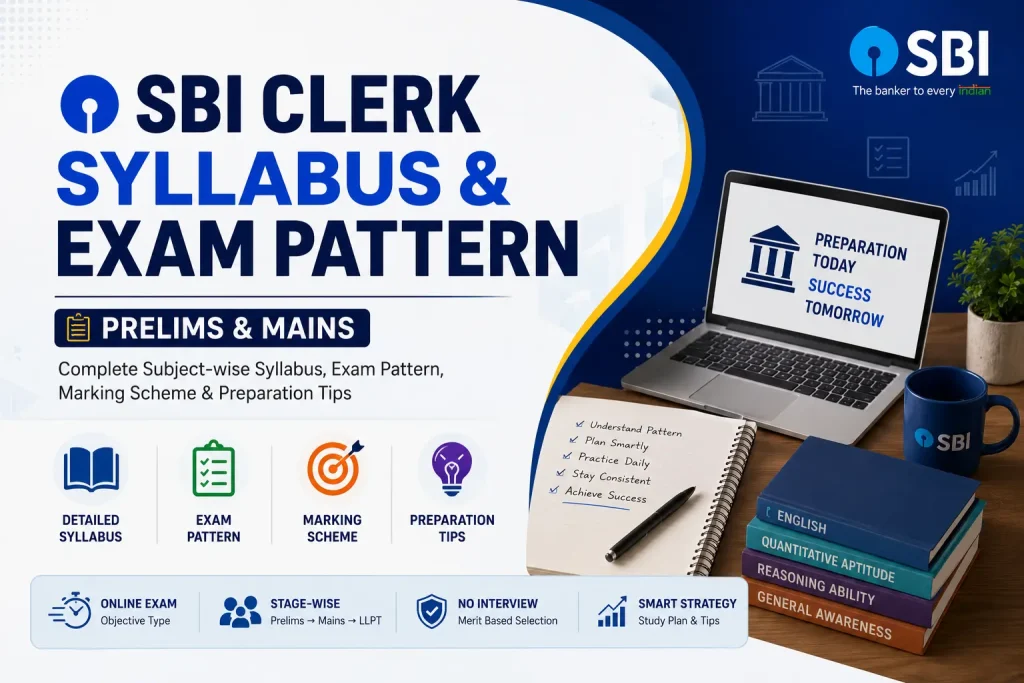
Quick Highlights Table
| Particulars | Details |
|---|---|
| Conducting Body | State Bank of India (SBI) |
| Post Name | Junior Associate (Customer Support & Sales) |
| Exam Level | National |
| Selection Stages | Prelims → Mains → Local Language Proficiency Test |
| Prelims Total Marks | 100 |
| Mains Total Marks | 200 |
| Prelims Duration | 60 minutes |
| Mains Duration | 2 hours 40 minutes |
| Negative Marking | 0.25 marks deducted per wrong answer |
| Interview | Not applicable |
| Mode of Exam | Online (Objective type) |
| Language of Exam | English, Hindi, and Regional languages (except the English section) |
What is the SBI Clerk Exam?
The SBI Clerk exam is conducted by the State Bank of India to recruit Junior Associates for Customer Support and Sales roles across its branches in India. This is a front-desk banking job — you will be the face of the branch, handling customers, cash transactions, account opening, and day-to-day banking operations.
It is one of the most preferred government banking jobs because of job security, a respectable salary, allowances, and the prestige of working with India’s largest public sector bank. Every year, this exam attracts intense competition, which is exactly why understanding the syllabus and pattern properly, right from day one, gives you a real edge over the crowd.
SBI Clerk Selection Process
Before jumping into the syllabus, you need to understand how the entire selection works. The SBI Clerk selection process has three stages:
- Preliminary Examination – A screening-level test. It is qualifying in nature, which means your Prelims score does not get added to your final merit.
- Main Examination – This is the real scoring stage. Your final merit list is prepared purely based on Mains marks.
- Local Language Proficiency Test (LLPT) – Applicable only for candidates who cannot show proof of having studied the chosen local language in Class 10 or 12. It is qualifying in nature.
There is no interview in the SBI Clerk selection process. This is good news for many aspirants who feel nervous about personal interviews. Your entire selection depends on how well you perform in the written exams, which is why building real subject strength matters so much.
SBI Clerk Exam Pattern 2026 Overview
The SBI Clerk exam pattern is designed in two stages, and both stages test different levels of difficulty. Prelims checks your basic speed and accuracy. Mains checks your depth of knowledge, especially in General Awareness and Computer Aptitude, along with tougher Reasoning and Quant questions.
Let’s break down each stage properly.
Prelims Exam Pattern
The SBI Clerk Prelims exam carries 100 marks and has to be completed in 60 minutes, with a strict sectional time limit of 20 minutes per section.
| Section | No. of Questions | Marks | Duration |
|---|---|---|---|
| English Language | 30 | 30 | 20 minutes |
| Numerical Ability | 35 | 35 | 20 minutes |
| Reasoning Ability | 35 | 35 | 20 minutes |
| Total | 100 | 100 | 60 minutes |
Key points about Prelims pattern:
- Each section has its own 20-minute timer. You cannot use extra time from one section to finish another. If your English section time is over, the system moves you to the next section automatically.
- Every wrong answer costs you 0.25 marks (1/4th of the marks allotted to that question).
- There is generally no penalty for questions you leave unattempted.
- Prelims marks are only used to shortlist candidates for Mains — they don’t count in your final selection.
Because of the sectional timing, a lot of students struggle here, not due to lack of knowledge but due to poor time management. That’s something we’ll fix later in the preparation strategy section.
Mains Exam Pattern
The SBI Clerk Mains exam is bigger, tougher, and far more important since your final merit is based entirely on this stage. It carries 200 marks, has 190 questions, and runs for 2 hours 40 minutes with sectional timing in place.
| Section | No. of Questions | Marks | Duration |
|---|---|---|---|
| General/Financial Awareness | 50 | 50 | 35 minutes |
| General English | 40 | 40 | 35 minutes |
| Quantitative Aptitude | 50 | 50 | 45 minutes |
| Reasoning Ability & Computer Aptitude | 50 | 60 | 45 minutes |
| Total | 190 | 200 | 160 minutes |
Key points about the mains pattern:
- Reasoning Ability & Computer Aptitude carries the highest weightage in Mains at 60 marks — this alone tells you where to invest extra revision time.
- Just like Prelims, each section has its own separate timer.
- Negative marking of 0.25 marks per wrong answer applies here too.
- All sections except General English are usually available in both English and Hindi (and the regional language, depending on the state).
- There is generally no individual sectional cut-off, but you still need a good aggregate score to make it to the merit list, since final selection is state-wise and category-wise.
Difference Between Prelims and Mains
Many first-time aspirants assume the Prelims and Mains test the same thing at the same difficulty level. That’s a mistake that costs people their rank. Here’s a simple comparison to clear the confusion:
| Feature | Prelims | Mains |
|---|---|---|
| Number of Questions | 100 | 190 |
| Marks | 100 | 200 |
| Duration | 60 minutes | 2 hours 40 minutes |
| Subjects | English, Numerical Ability, Reasoning | English, Quant, Reasoning & Computer Aptitude, General/Financial Awareness |
| Difficulty | Easy to Moderate | Moderate to Difficult |
| Purpose | Screening candidates for Mains | Deciding final selection |
| Final Merit | Not counted | Fully counted |
| Negative Marking | 0.25 marks per wrong answer | 0.25 marks per wrong answer |
In short, Prelims decides whether you get a chance. Mains decides whether you get the job. Treat them with that difference in mind.
SBI Clerk Prelims Syllabus
Now let’s go topic by topic. This is the part most students skim through, but this is exactly where marks are won or lost. Understanding each topic properly, instead of just reading a list, will save you weeks of confused preparation.
Here’s a quick-scan summary before the detailed breakdown:
| Subject | Important Topics | Difficulty Level | Preparation Priority |
|---|---|---|---|
| English Language | Reading Comprehension, Cloze Test, Error Detection, Sentence Improvement, Para Jumble, Fillers, Vocabulary | Moderate | High |
| Numerical Ability | Simplification & Approximation, Number Series, Quadratic Equations, Data Interpretation, Profit & Loss, SI/CI, Time & Work, Time-Speed-Distance, Ratio & Proportion, Average, Mensuration | Moderate to Difficult | High |
| Reasoning Ability | Puzzle & Seating Arrangement, Blood Relation, Coding-Decoding, Syllogism, Direction Sense, Alphabet & Number Series, Order & Ranking, Inequality, Input-Output | Easy to Moderate | High |
Reasoning Ability
Reasoning is a scoring section if you practice it the right way, because it’s less about “knowledge” and more about pattern recognition and logical thinking. Here are the important topics:
- Puzzle and Seating Arrangement – This is the single most important topic in Reasoning. Expect circular arrangement, linear arrangement (single/double row), box-based puzzles, floor puzzles, and month/date-based puzzles. Almost 15–20 marks in Prelims can come from this topic alone.
- Blood Relation – Questions based on family trees and relationships. Practice with diagrams until you can solve them without drawing every single time.
- Coding-Decoding – Letters, numbers, or words coded using a logical pattern. New coding formats keep appearing, so practice recent-pattern questions, not just old-style direct coding.
- Syllogism – Statements and conclusions based on Venn diagram logic. Master the basic rules first; this topic becomes very fast to solve once the rules click.
- Direction Sense – Based on movement in different directions to find distance or final direction. Draw rough diagrams; don’t try to solve it mentally.
- Alphabet and Number Series – Testing your ability to identify patterns quickly.
- Order and Ranking – Position-based questions, usually simple once you draw a number line.
- Input-Output – Machine-based step-by-step arrangement questions. This has reduced in newer patterns but still appears occasionally.
- Inequality – Mathematical symbols denoting relationships; direct and coded inequality should be practiced.
Where beginners struggle: Most students lose time in puzzles because they try to solve everything in their head. Toppers always draw quick, rough diagrams on paper, which actually saves time, not wastes it.
Quantitative Aptitude
This section tests your basic mathematics and calculation speed. It has the reputation of being “toughest to finish on time,” so accuracy with speed is the real goal here.
- Simplification and Approximation – Usually, the first questions you should attempt, since they are quick, direct, calculation-based questions. BODMAS rules and squares/cubes/tables up to 30 should be on your fingertips.
- Data Interpretation (DI) – Bar graphs, pie charts, tables, and line graphs. In Prelims, DI is usually simpler; in Mains, it gets calculation-heavy and sometimes combined with missing data (caselet DI).
- Quadratic Equations – Finding relationships between two equations. A high-scoring, low-time-consuming topic if practiced well.
- Number Series – Finding the missing or wrong number in a sequence. Practice different series patterns (difference-based, ratio-based, square-cube-based).
- Arithmetic Word Problems – This is a broad and important bucket covering:
- Profit and Loss
- Simple Interest and Compound Interest (SI & CI)
- Time and Work
- Time, Speed, and Distance
- Boats and Streams
- Ratio and Proportion
- Partnership
- Average
- Ages
- Mixture and Alligation
- Mensuration and Geometry – Area, perimeter, and volume-based questions on 2D and 3D shapes.
Where beginners struggle: Students often try to master every topic equally, which is inefficient. In reality, Simplification, Number Series, and Arithmetic word problems together form the bulk of scoring questions. Master these first, then move to DI and Quadratic Equations.
English Language
This section checks your grammar, vocabulary, and comprehension skills. Many non-English-medium students fear this section the most, but it is actually one of the most improvable sections with daily practice.
- Reading Comprehension (RC) – A passage followed by questions on meaning, inference, synonyms/antonyms, and vocabulary usage. Read the passage actively; don’t just skim.
- Cloze Test – A passage with blanks where you choose the most suitable word. This tests contextual vocabulary, not just grammar.
- Error Detection / Spotting Errors – Identifying grammatical mistakes in given sentences. Common areas: subject-verb agreement, tenses, articles, and prepositions.
- Sentence Improvement – Choosing the grammatically correct and most appropriate replacement for an underlined part of a sentence.
- Para Jumble – Rearranging jumbled sentences into a meaningful paragraph. Look for the “opening sentence” and connecting words (however, therefore, this, etc.) to solve faster.
- Fillers (Single and Double) – Filling blanks in a sentence with the most contextually correct word or word pair.
- Vocabulary Building – Regular reading habits and a daily new-word list help massively here — this is not a topic you can cram in the last week.
Where beginners struggle: Most students try to memorise grammar rules like a textbook. The smarter approach is to read English newspapers or editorial articles daily — this naturally builds grammar sense along with vocabulary.
SBI Clerk Mains Syllabus
Mains has everything from Prelims but at a tougher level, plus two additional subjects: General/Financial Awareness and Computer Aptitude. Let’s cover each one.
Here’s a quick-scan summary before the detailed breakdown:
| Subject | Important Topics | Marks | Expected Difficulty | Preparation Priority |
|---|---|---|---|---|
| Reasoning Ability & Computer Aptitude | Advanced Puzzles, Seating Arrangement, Syllogism, Data Sufficiency, Coding-Decoding, MS Office, Internet Basics, Computer Fundamentals | 60 | Difficult | High |
| Quantitative Aptitude | Data Interpretation (multi-set/caselet), Quadratic Equations, Number Series, Simplification, Arithmetic Word Problems, Mensuration, Probability, Data Sufficiency | 50 | Difficult | High |
| General/Financial Awareness | Banking Awareness, Financial Awareness, Current Affairs (last 6 months), Static GK | 50 | Moderate | High |
| General English | Reading Comprehension, Cloze Test, Error Detection, Sentence Improvement, Para Jumble, Fillers, Vocabulary | 40 | Moderate to Difficult | Medium |
Reasoning Ability & Computer Aptitude
This is the highest-weightage section in Mains (60 marks), so give it serious attention.
Reasoning topics (advanced level compared to Prelims):
- Advanced and high-level puzzles (multiple parameters combined — floor + box + designation type puzzles)
- Seating arrangement with more variables
- Syllogism with more complex statements
- Blood relation and direction sense (slightly tougher versions)
- Data Sufficiency
- Coding-Decoding (advanced patterns)
- Logical Reasoning (statement and assumption, course of action, cause and effect)
Computer Aptitude topics:
- Basics of computers, generations of computers
- Computer hardware and software
- Operating System basics
- MS Office (MS Word, Excel, PowerPoint)
- Internet, networking basics, and computer security
- Shortcut keys and basic computer terminology
- Number systems and computer memory (basic level)
Why this matters: Since this section combines two subjects into one, it is high-scoring for students who prepare Computer Aptitude well, because computer questions are usually direct and fact-based — no calculation, no lengthy puzzle-solving. Many toppers treat Computer Aptitude as “free marks” if revised properly.
General/Financial Awareness
This subject appears only in Mains and can be a real differentiator, because it needs consistent daily effort, not last-minute cramming.
- Banking Awareness – RBI functions, monetary policy basics, types of bank accounts, financial institutions, banking terms, and the history of Indian banking.
- Financial Awareness – Budget basics, financial schemes, insurance basics, capital markets basics, important financial bodies (SEBI, IRDAI, etc.)
- Current Affairs – The last 6 months are the most important: government schemes, appointments, awards, summits, sports events, important days, obituaries, and banking sector news.
- Static General Knowledge – Important days, national parks, headquarters of important organisations, currencies, and capitals.
Where beginners struggle: Students either ignore this section completely or try to read everything randomly. The smart way is to follow one reliable daily current affairs source and revise monthly compilations regularly — consistency wins here, not bulk reading in the last week.
General English
The Mains English syllabus covers the same core topics as Prelims, but with a higher difficulty level and additional formats:
- Reading Comprehension (longer and tougher passages, sometimes with vocabulary-based sub-questions)
- Cloze Test (advanced level)
- Error Detection
- Sentence Improvement
- Para Jumble
- Fillers
- Word usage and vocabulary-based questions
- Sometimes, sentence connectors and phrase replacement questions also appear
Quantitative Aptitude
Mains Quant is calculation-heavy and time-consuming, so this is where many candidates lose their aggregate score. Key topics:
- Data Interpretation (multiple sets, sometimes with missing data / caselet-based DI)
- Quadratic Equations
- Number Series
- Simplification and Approximation
- Arithmetic word problems (all sub-topics same as Prelims but tougher)
- Mensuration
- Probability
- Permutation and Combination (occasionally)
- Data Sufficiency (based on Quant)
Where beginners struggle: DI sets in Mains often combine two or three sub-questions requiring multi-step calculations. Practicing calculation shortcuts (squares, cubes, percentage-fraction conversion table) makes a big speed difference here.
Important Topics With Highest Weightage
Here’s a quick reference table so you know exactly where to focus your energy first.
| Subject | Topic | Importance | Why It Matters |
|---|---|---|---|
| Reasoning | Puzzle & Seating Arrangement | Very High | Forms the largest chunk of questions in both stages; mastering this directly boosts overall attempt count |
| Quantitative Aptitude | Arithmetic Word Problems | Very High | Recurs heavily across Prelims and Mains; strong basics here speed up multiple other topics |
| Quantitative Aptitude | Data Interpretation | Very High | Carries multiple questions per set in Mains, making it a high-return topic per minute invested |
| English | Reading Comprehension | High | Longest-weightage single topic in English; also builds vocabulary needed for Cloze Test and Fillers |
| Computer Aptitude | MS Office & Internet Basics | High | Fact-based and quick to answer, making it near-guaranteed scoring territory in Mains |
| General Awareness | Banking & Current Affairs | High | Only appears in the mains but needs months of preparation, making early consistency essential |
| Reasoning | Syllogism & Coding-Decoding | Moderate | Rule-based topics that become very fast to solve once the underlying logic is practiced |
| Quantitative Aptitude | Quadratic Equations & Number Series | Moderate | Low time-investment, high-accuracy topics that are ideal for quick scoring in the first few minutes |
Difficulty Level
Based on how the exam has generally been structured in recent years:
- Prelims is usually rated Easy to Moderate. English tends to be slightly tricky for many candidates, while Reasoning and Quant are largely doable with regular practice.
- Mains is rated Moderate to Difficult, mainly because of a tougher Quant section and the added pressure of General Awareness and Computer Aptitude, both of which need separate preparation time.
- SBI Clerk is often considered a notch tougher than IBPS Clerk, even though the overall structure and subjects are quite similar. So don’t underestimate your preparation just because you’ve cleared similar-level exams before.
Best Preparation Strategy
There is no single “best” way to prepare — it depends on how much time you have every day. Here are three tailored strategies.
Beginner Strategy (Starting from Scratch)
- Spend the first 2–3 weeks building basics in Quant (tables, squares, cubes, percentages) and Reasoning fundamentals (rules of syllogism, basic puzzles).
- Start reading English newspapers or simple editorials daily from Day 1 — vocabulary takes time to build.
- Don’t jump into mock tests immediately. Build topic-wise strength first, then start sectional tests.
- Once comfortable with individual topics, move to full-length mock tests, ideally starting 4–5 weeks before the exam.
Working Professional Strategy
- Since time is limited, prioritise high-weightage topics first (Puzzles, Arithmetic, RC, Cloze Test).
- Use commute time for vocabulary building and current affairs (audio/video formats work well here).
- Dedicate weekends to full-length mock tests and detailed error analysis.
- Keep a fixed 1.5–2 hour daily study window and protect it strictly — consistency matters more than long, irregular study sessions.
College Student Strategy
- You likely have more free time — use it to build a strong Reasoning and Quant foundation, since these need the most practice repetitions.
- Attempt at least 3–4 sectional tests every week once the basics are covered.
- Don’t neglect General Awareness just because Mains feels far away — start a daily current affairs habit early.
- Use group study or peer discussion for Puzzle and DI topics — discussing different approaches often speeds up your solving methods.
Recommended Time Allocation
Use this as a rough daily study planner based on your preparation stage:
| Subject | Daily Time (Beginner) | Daily Time (Intermediate) | Daily Time (Working Professional) |
|---|---|---|---|
| Reasoning Ability | 1.5 hours | 1 hour | 30 minutes |
| Quantitative Aptitude | 1.5 hours | 1 hour | 30 minutes |
| English Language | 1 hour | 45 minutes | 20 minutes |
| General/Financial Awareness | 30 minutes | 30 minutes | 20 minutes |
| Computer Aptitude | 30 minutes | 20 minutes | 15 minutes |
| Mock Test & Analysis | 1 hour | 1.5 hours | 45 minutes |
Preparation Tips
- Attempt mock tests under real exam conditions — sectional timing, no pausing, no distractions. This builds real exam temperament.
- Analyse every mock test properly. Don’t just check your score; understand which topics are costing you time and marks.
- Revise formulas weekly, especially for Quant. Formulas fade from memory quickly if not revised regularly.
- Practice previous year papers to understand the real difficulty level and question style, not just guess from generic practice sets.
- Build a daily current affairs habit at least 3 months before the exam — this cannot be crammed in the last 10 days.
- Focus on accuracy before speed. Negative marking punishes guesswork, so build a habit of attempting only what you’re reasonably confident about, especially in the early stages of preparation.
- Track your sectional timing in every practice test — this is one of the most underrated preparation habits.
Common Mistakes Students Make
- Ignoring sectional timing during practice – Then struggling badly with time management on the actual exam day.
- Over-focusing on one subject – Some students spend 70% of their time on Quant and completely neglect English or General Awareness, hurting their overall score.
- Starting mock tests too early or too late – Too early means low scores that demotivate you; too late means you don’t get enough attempts to build exam temperament.
- Not revising Computer Aptitude – Students assume it’s “easy” and skip revision, then lose easy marks in Mains.
- Cramming current affairs in the last week – This subject needs months of consistent reading, not last-minute cramming.
- Not analysing mistakes – Simply attempting mock test after mock test without reviewing errors is one of the biggest preparation traps.
- Ignoring the syllabus PDF and official notification – Many students prepare from outdated syllabus versions. Always cross-check with the latest official notification once released.
Best Books
While mock tests and online practice matter the most today, having a few reliable books for concept-building helps, especially for Quant and Reasoning fundamentals.
- Quantitative Aptitude – A Modern Approach to Verbal & Non-Verbal Reasoning (R.S. Aggarwal) for Reasoning fundamentals, along with Fast Track Objective Arithmetic for Quant basics.
- English Language – Word Power Made Easy for vocabulary building, along with any standard grammar reference like Wren & Martin for concept clarity.
- General Awareness – Any trusted monthly current affairs compilation, along with a banking awareness capsule closer to the Mains exam.
- Computer Awareness – Any standard computer awareness book covering basic computer fundamentals and MS Office.
Books are best used for building concepts. For real exam practice and speed-building, mock tests remain irreplaceable.
Best Online Mock Test
Along with books, regular mock test practice is non-negotiable for SBI Clerk preparation. Some of the platforms widely used by banking aspirants include:
- Oliveboard – Known for its detailed performance analysis and All-India mock test series that closely mirror the actual exam interface.
- PracticeMock – Offers structured sectional and full-length mock tests along with topic-wise practice sets for both Prelims and Mains.
- Testbook – A popular choice for its large test series library covering multiple banking exams, including SBI Clerk.
If you’re planning to subscribe to any of these platforms, it’s worth checking the latest coupon codes available on Karmasetu.in before purchasing — you may be able to save a bit on your test series subscription.
Preparation Timeline
Whether you’re starting fresh or doing a final revision, here’s how to structure your remaining time:
| Time Left | What to Focus On | Mock Tests | Revision |
|---|---|---|---|
| 90 Days | Building core concepts in Quant & Reasoning, starting an English reading habit, and light current affairs | 1–2 sectional tests per week | Weekly formula and rule revision |
| 60 Days | Covering all high-weightage topics, increasing current affairs intensity, starting Computer Aptitude basics | 4–5 sectional/full tests per week | Bi-weekly revision of weak topics and formulas |
| 30 Days | High-intensity revision of all subjects, previous year paper practice, sectional timing drills | Daily full-length mock test | Daily short revision of formulas, current affairs capsules and error logs |
The 30-day plan works best if you already have some prior preparation — it’s built for revision and speed, not for learning topics from scratch.
Frequently Asked Questions (FAQs)
The SBI Clerk syllabus covers English Language, Quantitative Aptitude, and Reasoning Ability for Prelims, with the addition of General/Financial Awareness and Computer Aptitude for Mains.
Yes. For every wrong answer, 0.25 marks are deducted in both Prelims and Mains. There is generally no penalty for unattempted questions.
There are three stages: Prelims, Mains, and the Local Language Proficiency Test (applicable for candidates without local language proof from Class 10 or 12).
No, there is no interview for the SBI Clerk post. Final selection is based purely on Mains marks.
Prelims carries 100 marks, and Mains carries 200 marks.
No, Prelims is qualifying in nature. Only Mains marks decide your final selection.
The Mains exam duration is 2 hours 40 minutes, with sectional timing for each of the four sections.
Puzzle and Seating Arrangement carry the highest weightage in the Reasoning section.
No, Computer Aptitude is combined with Reasoning Ability as a single section in Mains, carrying a total of 60 marks.
SBI Clerk is generally considered slightly tougher than IBPS Clerk, even though the subjects and pattern are broadly similar.
Yes, if you already have some foundational preparation. A focused 30-day revision plan with daily mock tests and error analysis can help you perform well.
You can refer to the official SBI notification once released for the most accurate and updated syllabus PDF, and cross-check details with trusted resources like Karmasetu.in.
Each section in Prelims has a fixed sectional time limit of 20 minutes, and time cannot be shared between sections.
Ideally, aim for at least 25–30 full-length mock tests along with regular sectional tests in the final 6–8 weeks before the exam, depending on your available time.
Conclusion
The SBI Clerk exam may look intimidating at first, especially with two stages, sectional timing, and four subjects in Mains. But once you break the syllabus down topic by topic, like we’ve done here, it becomes a lot more manageable.
Success in this exam isn’t about studying the most hours — it’s about studying the right topics, consistently, with proper mock test practice and honest error analysis. Thousands of aspirants clear this exam every year, and there’s no reason you can’t be one of them with focused, smart preparation.
Please note that SBI may update the syllabus or exam pattern slightly with the official notification. Always cross-check the latest details once SBI releases the official SBI Clerk 2026 notification.
Start today, stay consistent, and trust the process. Your Junior Associate posting at SBI is closer than it feels.
Related Articles You May Find Useful
- SBI Clerk Notification 2026
- SBI Clerk Eligibility
- SBI Clerk Salary
- Best SBI Clerk Mock Test

Karmasetu is a dedicated team of government job researchers and exam
enthusiasts based in West Bengal. With a combined experience of tracking
central and state government recruitments across India, the team covers
SSC, Railway, Banking, Defence, and State PSC notifications — verified
directly from official sources.
Our goal is simple: give every job seeker in India accurate, timely,
and easy-to-understand recruitment information so they never miss an
opportunity. Every article on Karmasetu is written after reading the
official notification PDF, cross-checked for eligibility details, and
updated whenever official changes are announced.
Follow us on Telegram (@karmasetu) for instant job alerts.
