

If you are preparing for the SBI Clerk exam, chances are the salary is one of the first things you searched for. And that’s fair — before you spend months preparing, you deserve to know what you’re working towards.
The good news? SBI Clerk, officially called Junior Associate (Customer Support & Sales), is one of the most sought-after clerical jobs in Indian banking. It offers a solid starting pay, steady increments, generous allowances, and a genuine path to becoming a bank officer.
In this guide, we’ll break down the SBI Clerk Salary 2026 in plain language — no jargon, no confusing pay-scale codes without explanation. You’ll get the basic pay, in-hand salary, allowances, deductions, a sample salary slip, promotion path, and how your earnings could look after 5 or 10 years.
Note: SBI salaries are governed by periodic Bipartite Settlements between banks and employee unions, and Dearness Allowance (DA) is revised every few months. So treat the figures below as close approximations based on the currently applicable pay scale, not fixed numbers carved in stone.
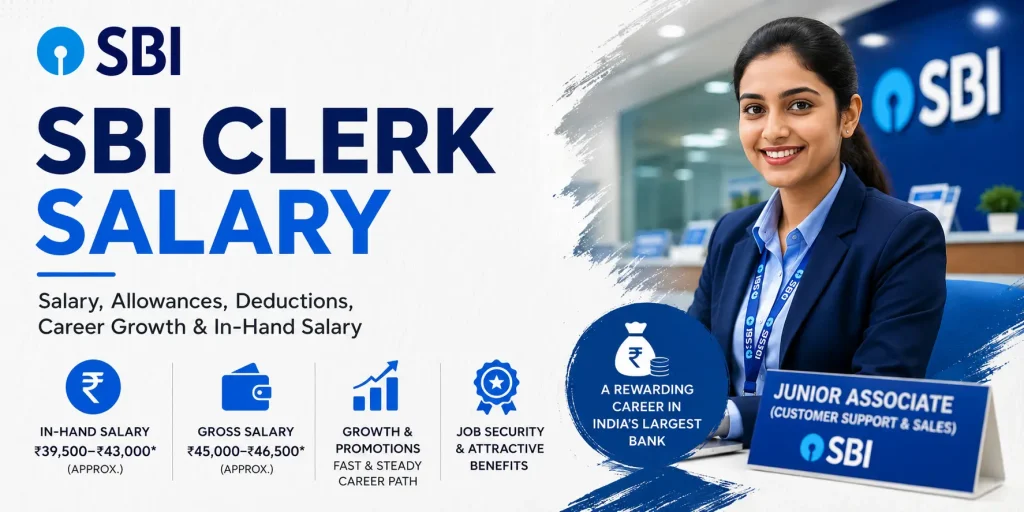
Quick Salary Highlights Table
| Particulars | Approximate Figures (2026) |
|---|---|
| Post | Junior Associate (Customer Support & Sales) |
| Starting Basic Pay | ₹26,730 (₹24,050 + 2 advance increments for graduates) |
| Pay Scale | ₹24,050–64,480 (with periodic increments) |
| Gross Starting Salary (Metro) | ₹45,000–₹46,500 approx. |
| In-Hand Salary (Starting) | ₹39,500–₹43,000 approx. (varies by city) |
| Probation Period | 6 months (may extend in some cases) |
| Basic Pay After 5 Years | ₹32,000–₹33,000 approx. |
| Basic Pay After 10 Years | ₹41,000–₹42,000 approx. |
| Maximum Basic Pay (Top of Scale) | ₹64,480 |
| Promotion Route | Fast Track (6 yrs), Normal Track (12 yrs), Trainee Officer route (3 yrs) |
SBI Clerk Salary 2026: An Overview
SBI Clerk is not just “a government job.” It’s a career that starts with respectable pay and, more importantly, keeps growing. Every year, your basic pay increases through fixed increments. On top of that, allowances rise whenever DA is revised, which usually happens more than once a year.
This is different from many private-sector roles where hikes depend on appraisals, targets, and company performance. In SBI, the increment structure is written into your pay scale from day one. You know almost exactly what your basic pay will look like in year 3, year 5, or year 10.
That predictability is a big reason lakhs of graduates choose to prepare seriously for this exam every year.
SBI Clerk Pay Scale 2026
The current pay scale for SBI Junior Associates looks like this:
₹24,050 – 1340/3 – 28,070 – 1650/3 – 33,020 – 2000/4 – 41,020 – 2340/7 – 57,400 – 4400/1 – 61,800 – 2680/1 – 64,480
This might look intimidating, but it’s simple once explained:
- You start at a basic pay of ₹24,050.
- For the first 3 years, your pay increases by ₹1,340 every year.
- For the next 3 years, it increases by ₹1,650 every year.
- Then for 4 years, the increment is ₹2,000 per year.
- This continues in similar stages until the basic pay eventually reaches the top of the scale, ₹64,480, after roughly 17–19 years of service (assuming you remain in the clerical cadre).
If you’re a graduate, you get two advance increments right at joining. That’s why your actual starting basic pay is ₹26,730 instead of ₹24,050.
Most clerks, however, don’t stay in this scale for the full duration — many move to the officer cadre through internal promotions well before reaching the top.
Monthly In-Hand Salary of SBI Clerk
This is what most aspirants actually care about — how much lands in your bank account every month.
Based on the current pay scale and DA rates, a fresher SBI Clerk can expect:
- Gross salary: approximately ₹45,000–₹46,500 per month (higher in metro cities due to HRA)
- In-hand salary: approximately ₹39,500–₹43,000 per month, after standard deductions
The exact number depends on your city of posting. A clerk posted in Mumbai or Delhi will usually see a higher gross salary than one posted in a semi-urban or rural branch, mainly because HRA is location-linked.
It’s worth repeating: these are approximate figures. Your actual salary slip may show a slightly different number depending on the latest DA rate applicable at the time and any recent bipartite settlement revisions.
Allowances in SBI Clerk Salary
This is where the SBI Clerk salary structure genuinely shines. Allowances aren’t just “extra pocket money” — they meaningfully add to your monthly income and, in some cases, to your quality of life.
Here are the major SBI Clerk allowances:
- Dearness Allowance (DA): Linked to inflation and revised periodically. This is calculated as a percentage of basic pay and forms a large chunk of your gross salary.
- House Rent Allowance (HRA): Varies by the city you’re posted in. Metro postings get a higher HRA percentage than rural postings.
- Transport Allowance (TA): A fixed monthly amount to cover commuting costs.
- Special Allowance: A significant component added on top of basic pay, which effectively boosts your take-home without being counted as basic pay for pension purposes.
- Medical Allowance/Reimbursement: Covers medical expenses for the employee and dependents.
- Furniture Allowance: A one-time or periodic benefit for home furnishing, applicable to certain grades.
- Newspaper/Magazine Allowance: A small monthly amount for staying updated with current affairs — genuinely useful, given the nature of banking work.
- Leave Fare Concession (LFC): Reimbursement for travel during leave, once every few years.
What makes SBI’s allowance package attractive compared to many other banks is the leased accommodation facility available in certain postings, along with consistently updated Special Allowance components after every bipartite settlement. Together, these push the effective in-hand income noticeably higher than the basic pay alone would suggest.
Deductions from SBI Clerk Salary
Your gross salary isn’t what you take home. A few standard deductions apply every month:
- National Pension System (NPS) contribution — a portion of your basic pay + DA goes towards your retirement corpus, with SBI also contributing.
- Professional Tax — a small state-level tax that varies by state.
- Income Tax (TDS) — applicable once your annual income crosses the taxable threshold, deducted as per applicable slab rates.
- Other minor deductions — such as staff welfare fund contributions, in some cases.
Typically, total deductions for a fresher clerk add up to roughly ₹3,000–₹4,500 per month, though this can vary based on your tax slab and location.
💡 Prepping on a budget? If you’re planning to enroll in mock test series or online courses for SBI Clerk, check CouponEdge’s exam mock tests & courses coupons before you pay — it’s a quick way to save on your preparation costs.
SBI Clerk Salary Slip Example
Here’s an illustrative (approximate) salary slip for a fresher SBI Clerk posted in a metro city. Please treat this as an example for understanding, not an exact figure — your real slip will vary based on posting and DA rate at the time.
| Component | Approximate Amount (₹) |
|---|---|
| Basic Pay | 26,730 |
| Dearness Allowance (DA) | 12,500 |
| House Rent Allowance (HRA) | 3,200 |
| Transport Allowance | 900 |
| Special Allowance | 2,800 |
| Gross Salary | ~46,000 |
| NPS Deduction | 2,700 |
| Professional Tax | 200 |
| Other Deductions | 800 |
| Total Deductions | ~3,700 |
| Net In-Hand Salary | ~42,300 |
Again — this is a representative breakup to help you understand the structure. Your actual salary slip figures will depend on the current DA rate, city of posting, and applicable deductions at that time.
Probation Period for SBI Clerk
Once you’re selected, you don’t start as a fully confirmed employee immediately. SBI Clerks typically undergo a probation period of 6 months. During this time:
- You receive full salary and allowances as applicable.
- You’re expected to complete internal training and get familiar with branch operations.
- Your performance is assessed before final confirmation.
In some cases, based on training performance, the probation period may be extended slightly — but this isn’t common if you put in reasonable effort.
SBI Clerk Job Profile
An SBI Clerk (Junior Associate) is essentially the face of the bank for most customers. If you’ve ever walked into an SBI branch, the person who helped you at the counter was likely a Junior Associate.
Core responsibilities include:
- Handling cash deposits and withdrawals
- Processing cheques and demand drafts
- Opening and closing customer accounts
- Updating passbooks
- Assisting with loan documentation
- Addressing customer queries and complaints
- Cross-selling banking products like insurance or investment schemes
As you gain experience, you may move from a general counter role (called Single Window Operator – A, or SWO-A) to more specialized responsibilities like cash-in-charge, locker-in-charge, or handling clearing and documentation work.
Daily Work Life of an SBI Clerk
A typical day involves:
- Reaching the branch before customer hours to prepare the counter
- Handling a steady stream of customer transactions throughout the day
- Managing documentation for account opening, KYC updates, and loan applications
- Coordinating with officers for approvals on larger transactions
- Balancing cash and closing counter records at day-end
It’s a customer-facing, fairly fast-paced role, especially in busy urban branches. Rural and semi-urban postings tend to have a slightly slower pace but often come with added responsibilities since branch staff strength is smaller.
SBI Clerk Promotion Policy
This is where SBI Clerk stands out from most clerical jobs — the promotion pathway is well-defined and genuinely achievable.
There are two broad routes:
1. Trainee Officer (TO) Route
After completing a minimum of 3 years of service, clerks can appear for an internal Trainee Officer exam. Clearing this moves you into the officer cadre relatively early in your career.
2. Fast Track / Normal Track to JMGS-I (Officer Scale I)
- Fast Track: After a minimum of 6 years of service, eligible clerks can appear for promotion to Junior Management Grade Scale-I (Officer).
- Normal Track: After a minimum of 12 years of service, with similar eligibility conditions.
Both routes typically require:
- Passing the JAIIB (Junior Associate of Indian Institute of Bankers) exam
- Passing the CAIIB (Certified Associate of Indian Institute of Bankers) exam
- Clearing an internal written test and interview
3. Seniority-Based Promotions Within the Clerical Cadre
Even if you don’t move to the officer cadre, SBI has structured milestones within the clerical role itself:
- After 10 years, you can become a Senior Assistant, with a special allowance of approximately ₹1,800.
- After 20 years, you may become a Special Assistant, with a special allowance of around ₹2,500.
- After 30 years, you can reach Senior Special Assistant, with a special allowance of about ₹3,500.
This means even without clearing officer-level exams, your income and designation keep improving steadily over your career.
Career Growth for SBI Clerk
Here’s the honest picture: SBI Clerk is often described as an entry point rather than a final destination. Many successful SBI officers — including those in senior management — started their careers as clerks and were promoted internally.
The general growth path looks like this:
Junior Associate → Officer (JMGS-I) → Middle Management (MMGS-II, MMGS-III) → Senior Management (SMGS-IV, SMGS-V) → Top Executive Grades (Deputy General Manager, General Manager, and beyond)
Of course, reaching the top requires consistent performance, clearing internal exams, and years of dedicated service. But the structure exists, and many employees do climb this ladder.
SBI Clerk Salary After 5 Years
By the 5-year mark, your basic pay typically moves to around the ₹32,000–₹33,000 range, based on the increment stages in the pay scale. Combined with DA hikes (which usually happen periodically) and allowance increases tied to basic pay, your gross salary and in-hand pay both see a noticeable jump compared to your starting figures.
While it’s tempting to pin an exact number, the honest answer is: it depends heavily on how DA has moved in those 5 years and where you’re posted. As a reasonable approximation, many clerks see their in-hand salary increase by ₹5,000–₹8,000 compared to their starting take-home by year 5.
SBI Clerk Salary After Promotion
If you clear the officer promotion exam (either Fast Track or Trainee Officer route), your salary moves entirely to the Officer Scale-I pay structure. This typically starts at a basic pay of around ₹48,480 (with applicable increments), pushing your in-hand salary to approximately ₹65,000–₹75,000 per month at the entry officer level — a substantial jump from the clerical cadre.
This is exactly why many clerks actively prepare for JAIIB, CAIIB, and internal promotion exams within their first few years of joining.
Perks & Benefits of SBI Clerk
Beyond the monthly salary, SBI Clerks enjoy a fairly comprehensive benefits package:
- Pension under NPS, with employer contribution
- Provident Fund
- Medical benefits for self and dependents
- Leave Fare Concession (LFC) for travel during vacations
- Leased accommodation facility in select postings
- Concessional loans for housing, vehicles, and personal needs (a genuine advantage of working in a bank)
- Job security, which is hard to overstate in today’s job market
Is the SBI Clerk Salary Good?
This depends on what you’re comparing it to. But looking at it practically:
- Compared to many private-sector entry-level jobs, SBI Clerk offers better job security, a clear increment structure, and long-term growth that most private roles simply don’t guarantee.
- The starting in-hand salary of roughly ₹40,000–₹43,000 is genuinely competitive for a graduate-level government role, especially outside metro cities where the cost of living is lower.
- The real value shows up over time — steady increments, DA revisions, and a legitimate path to officer-level pay make this a strong long-term career choice rather than just a “decent starting salary.”
This is precisely why many candidates — including engineers, postgraduates, and even those with private-sector experience — choose to prepare for SBI Clerk instead of chasing marginally higher private salaries that come with less stability.
SBI Clerk Salary vs IBPS Clerk Salary
Both SBI Clerk and IBPS Clerk (which covers various public sector banks like PNB, Bank of Baroda, Canara Bank, etc.) follow the same broad Bipartite Settlement pay scale. So on paper, the basic pay structures look nearly identical.
| Aspect | SBI Clerk | IBPS Clerk |
|---|---|---|
| Basic Pay Scale | Same bipartite structure | Same bipartite structure |
| Special Allowance | Generally higher | Comparatively lower in some banks |
| Leased Accommodation | Available in select postings | Less commonly offered |
| Brand Value & Exposure | Very high (largest PSU bank) | Varies by participating bank |
| Promotion Pathway | Well-structured, widely used | Varies by bank |
The main difference in actual take-home pay usually comes from SBI’s slightly higher Special Allowance component and the leased accommodation benefit, which many other IBPS-participating banks don’t offer in the same way. This is a big reason SBI Clerk remains the more preferred choice among the two for most aspirants.
Frequently Asked Questions (FAQs)
1. What is the SBI Clerk starting salary in 2026?
The starting basic pay is approximately ₹26,730, with an in-hand salary generally between ₹39,500 and ₹43,000 per month, depending on posting location.
2. What is the SBI Clerk pay scale?
The pay scale is ₹24,050–1340/3–28,070–1650/3–33,020–2000/4–41,020–2340/7–57,400–4400/1–61,800–2680/1–64,480.
3. What is the SBI Clerk’s in-hand salary after all deductions?
It’s approximately ₹39,500–₹43,000 per month for a fresher, though exact figures vary by city and current DA rate.
4. How much does an SBI Clerk’s salary increase after 5 years?
Basic pay typically rises to around ₹32,000–₹33,000 by year 5, along with proportionate increases in DA and other allowances.
5. Is SBI Clerk a permanent job?
Yes, after completing the probation period (typically 6 months), an SBI Clerk is a confirmed, permanent government bank job.
6. Can an SBI Clerk become an officer?
Yes. Clerks can appear for internal promotion exams through the Trainee Officer route (after 3 years) or the Fast Track/Normal Track route (after 6 or 12 years, respectively) to become Officer Scale-I.
7. What allowances are included in the SBI Clerk salary?
Major allowances include DA, HRA, TA, Special Allowance, Medical Allowance, Furniture Allowance, and Newspaper Allowance, among others.
8. Does the SBI Clerk salary vary by city?
Yes. HRA and, in some cases, overall gross salary are higher in metro cities compared to semi-urban or rural postings.
9. What is the maximum salary an SBI Clerk can earn?
Within the clerical cadre, basic pay can reach up to ₹64,480 at the top of the scale, though this takes many years, and most clerks move to officer roles before reaching it.
10. Is the SBI Clerk salary better than the IBPS Clerk salary?
Both follow a similar base pay scale, but SBI generally offers a higher Special Allowance and additional perks like leased accommodation, making its overall package slightly more attractive.
Conclusion
The SBI Clerk Salary 2026 package is more than just a starting figure — it’s a structured, growing income supported by regular increments, meaningful allowances, and one of the clearest promotion pathways in Indian public sector banking. Whether you eventually move up to become an officer or stay within the clerical cadre and rise through seniority-based promotions, your earning potential steadily improves year after year.
If financial stability, long-term growth, and job security matter to you, SBI Clerk is genuinely worth the preparation effort. Just remember that DA revisions and future bipartite settlements can adjust these figures, so always cross-check the latest official notification closer to your application.
Explore More SBI Clerk Resources:
- SBI Clerk Notification
- SBI Clerk Eligibility Criteria
- SBI Clerk Syllabus
- SBI Clerk Exam Pattern
- Best SBI Clerk Mock Test Series

Karmasetu is a dedicated team of government job researchers and exam
enthusiasts based in West Bengal. With a combined experience of tracking
central and state government recruitments across India, the team covers
SSC, Railway, Banking, Defence, and State PSC notifications — verified
directly from official sources.
Our goal is simple: give every job seeker in India accurate, timely,
and easy-to-understand recruitment information so they never miss an
opportunity. Every article on Karmasetu is written after reading the
official notification PDF, cross-checked for eligibility details, and
updated whenever official changes are announced.
Follow us on Telegram (@karmasetu) for instant job alerts.
