

If you’ve been grinding through mock tests and previous year papers for the IBPS Clerk exam, there’s a good chance one question keeps nagging you at the back of your mind: how much will I actually take home once I get the offer letter? Not the headline number in the notification, but the real figure that lands in your bank account.
This guide breaks down the IBPS Clerk salary 2026 the way a mentor would explain it over chai — basic pay, allowances, deductions, the real in-hand number, and what your salary looks like five, ten, and twenty years down the line. We’ll also cover the job profile, promotion path, and how IBPS Clerk stacks up against SBI Clerk, so you walk away with a complete picture before you commit months of preparation to this exam.
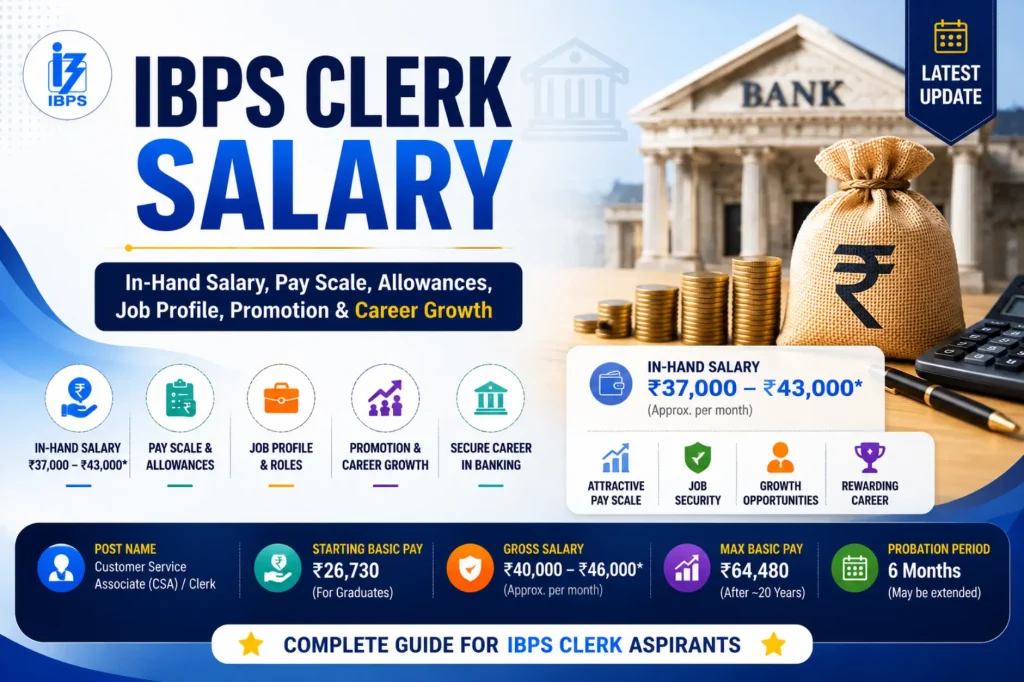
Latest Salary Update
The current IBPS Clerk salary structure is based on the 12th Bipartite Settlement between the Indian Banks’ Association (IBA) and bank employee unions, which pushed the starting basic pay from ₹19,900 (under the 11th BPS) up to ₹24,050 — roughly a 17% jump. Graduate candidates get two advance increments right at joining, which takes their effective starting basic pay to ₹26,730. This revised structure applies uniformly across all 11 public sector banks that recruit through IBPS.
Dearness Allowance is revised every quarter based on the Consumer Price Index, so your gross and in-hand figures will keep shifting slightly through the year even without a promotion. A 13th Bipartite Settlement will eventually bring the next major revision, but that’s still some years away, so the figures below reflect what a fresh recruit joining in 2026 can realistically expect.
Expert Tip
Don’t fixate on a single “final” salary number you see on a coaching website. Two clerks joining the same month can have in-hand salaries that differ by ₹1,000–₹2,000 purely because one is posted in Mumbai and the other in a Tier-3 town. Treat every figure here as a realistic range, not a guarantee.
Quick Highlights Table
| Particulars | Details |
|---|---|
| Post Name | Customer Service Associate (CSA) / Clerk |
| Recruiting Body | IBPS (for 11 Participating Public Sector Banks) |
| Pay Scale | ₹24,050 – 1340/3 – 28,070 – 1650/3 – 33,020 – 2000/4 – 41,020 – 2340/7 – 57,400 – 4400/1 – 61,800 – 2680/1 – 64,480 |
| Starting Basic Pay (Graduate) | ₹26,730 (₹24,050 + 2 advance increments) |
| Approx. Gross Salary | ₹40,000 – ₹46,000 per month |
| Approx. In-Hand Salary | ₹37,000 – ₹43,000 per month |
| Probation/Training Period | 6 months (may be extended) |
| Pension Scheme | National Pension System (NPS) |
| Increment Cycle | Annual, as per pay scale slabs |
| Maximum Basic Pay | ₹64,480 (after ~20 years) |
IBPS Clerk Salary 2026 Overview
The moment your result is out, your salary starts working on two levels simultaneously — the fixed component (basic pay, which grows only through increments and promotions) and the variable component (DA, HRA, and a few smaller allowances, which move with inflation and your posting city). Understanding this split matters because it explains why your salary in month one won’t look identical to your salary in month thirteen, even without any promotion.
Most freshers can expect a gross monthly salary in the ₹40,000–₹46,000 range, with the net in-hand amount settling somewhere between ₹37,000 and ₹43,000 after standard deductions. The exact figure depends heavily on your posting location, since HRA and a few allowances are city-tier linked.
IBPS Clerk Pay Scale
The IBPS Clerk pay scale under the 12th Bipartite Settlement runs as follows:
₹24,050 – 1340/3 – 28,070 – 1650/3 – 33,020 – 2000/4 – 41,020 – 2340/7 – 57,400 – 4400/1 – 61,800 – 2680/1 – 64,480
Reading a pay scale like this confuses most first-time aspirants, so here’s how to decode it: you start at ₹24,050, get an annual increment of ₹1,340 for the first 3 years (taking you to ₹28,070), then ₹1,650 per year for the next 3 years (up to ₹33,020), then ₹2,000 per year for 4 years (up to ₹41,020), then ₹2,340 per year for 7 years (up to ₹57,400), followed by two larger jumps that eventually cap the basic pay at ₹64,480 around the 20-year mark, assuming no promotion happens in between.
Expert Tip
Many aspirants focus only on the in-hand salary, but promotion opportunities and annual increments have a much bigger impact on long-term earnings. A clerk who clears the internal promotion exam within 3–5 years will out-earn a clerk who stays in the cadre for 10 years without attempting one — often by a wide margin.
Before you dive into the salary slip, it’s worth knowing the syllabus – check out our detailed IBPS Clerk Syllabus and Exam Pattern
IBPS Clerk In-Hand Salary
Featured Answer: What is IBPS Clerk In-Hand Salary? The IBPS Clerk in-hand salary for a fresh graduate recruit in 2026 is approximately ₹37,000 to ₹43,000 per month, after standard deductions like NPS contribution, professional tax, and union fees. This is the amount actually credited to your bank account, and it varies by posting city.
Gross Salary
Gross salary is simply basic pay plus all applicable allowances, before any deductions are made. For a fresh graduate joiner, gross salary typically works out to roughly ₹40,000–₹46,000 per month, with the higher end applying to metro postings where HRA is calculated at a higher percentage.
Basic Pay
Featured Answer: What is the Basic Pay? The base starting pay under the 12th Bipartite Settlement is ₹24,050 per month. Graduate candidates receive two advance increments at the time of joining, which raises their effective starting basic pay to ₹26,730. Non-graduates or those without the advance increment benefit start at the base ₹24,050.
Salary Structure
Your monthly salary slip is built in three layers:
- Basic Pay — the fixed foundation figure from the pay scale.
- Allowances — DA, HRA, Transport Allowance, Special Allowance, and a few smaller components, all typically calculated as a percentage of basic pay.
- Deductions — NPS, professional tax, and occasionally union or association fees, are subtracted from the gross to arrive at your net in-hand pay.
Detailed Salary Components Table
| Component | Approximate Monthly Amount (Fresh Graduate, Metro Posting) |
|---|---|
| Basic Pay | ₹26,730 |
| Dearness Allowance (DA) | ₹9,500 – ₹11,500 |
| House Rent Allowance (HRA) | ₹1,800 – ₹2,400 |
| Transport Allowance | ₹425 – ₹600 |
| Special Allowance | ₹4,800 – ₹5,500 |
| Other Minor Allowances | ₹300 – ₹600 |
| Gross Salary | ₹43,500 – ₹46,000 (approx.) |
| Total Deductions | ₹2,900 – ₹3,500 |
| Net In-Hand Salary | ₹40,000 – ₹43,000 (approx.) |
Note: These figures are indicative. Exact salary components may vary depending on posting location, applicable allowances, and future DA revisions.
Allowances
The allowance structure is what quietly turns a modest basic pay into a fairly livable monthly salary. Here’s what each component means in practice.
Dearness Allowance (DA)
DA is designed to offset the impact of inflation and is revised every quarter based on the Consumer Price Index for Industrial Workers (CPI-IW). It’s calculated as a percentage of your basic pay, and this percentage has been trending upward over recent quarters. Because it’s linked to inflation, DA is the single most dynamic part of your salary — it can genuinely change your take-home pay every three months without you doing anything differently.
House Rent Allowance (HRA)
HRA depends entirely on where you’re posted. IBPS categorizes cities into tiers, and clerks posted in larger, more expensive cities receive a higher HRA percentage than those posted in smaller towns. This is the single biggest reason two clerks with identical basic pay can have noticeably different in-hand salaries.
Transport Allowance
A fixed monthly amount meant to cover commuting costs. It’s modest compared to DA or HRA but adds a small, steady bump to your gross pay.
Special Allowance
Introduced as part of the bipartite settlement structure, this is calculated as a percentage of basic pay and forms a meaningful chunk of your gross salary, second only to DA.
Medical Benefits
Public sector banks offer medical insurance coverage for the employee, and in most cases, partial coverage for dependent family members too. Some banks also offer an annual medical aid reimbursement for routine check-ups.
Other Benefits
Beyond the monthly pay slip, clerks are entitled to Leave Fare Concession (LFC) for travel every couple of years, festival advances, newspaper reimbursement, and concessional interest rates on personal and housing loans through the bank.
Deductions
Provident Fund
A statutory retirement savings contribution is deducted from your salary, matched by an employer contribution.
NPS
Under the National Pension System, roughly 10% of (Basic Pay + DA) is deducted from your salary each month, with the bank contributing a larger share (commonly cited around 14%) on your behalf. This builds your retirement corpus over your service tenure.
Does IBPS Clerk get pension? Yes, but under the National Pension System (NPS), not the older defined-benefit pension scheme. NPS is a contribution-based retirement scheme where both you and the bank contribute monthly, and the accumulated corpus (plus market-linked returns) is available to you on retirement.
Professional Tax (if applicable)
A small state-level tax, usually a few hundred rupees a month, applicable depending on the state you’re posted in. Some states don’t levy this at all.
Income Tax
Applicable per standard income tax slabs based on your total annual salary and any deductions you claim under applicable sections. Fresh clerks with a modest starting salary often have minimal or no tax liability, especially after the standard deduction and rebate provisions.
Illustrative Salary Slip
| Component | Amount (₹) |
|---|---|
| Basic Pay | 26,730 |
| Dearness Allowance | 10,800 |
| House Rent Allowance | 2,100 |
| Transport Allowance | 500 |
| Special Allowance | 5,200 |
| Other Allowances | 400 |
| Gross Salary | 45,730 |
| NPS Deduction | 2,600 |
| Professional Tax | 200 |
| Union/Association Fee | 200 |
| Total Deductions | 3,000 |
| Net In-Hand Salary | 42,730 |
This is a representative slip for a metro posting; actual figures will shift with your city, bank, and the DA rate applicable in that quarter.
Expert Tip
When you get your first salary slip, don’t panic if the number looks lower than what a website promised. Check whether NPS, union fees, and any recovery for uniform/training kits have been deducted — these one-time or slightly variable deductions often explain the gap between the “expected” and “actual” figure in your first couple of months.
If you’re also exploring other clerical banking exams alongside this one, check out our SBI Clerk Salary and SBI Clerk Syllabus guides to see how the pay structure and exam syllabus compare with IBPS Clerk.
Job Profile
An IBPS Clerk, officially designated Customer Service Associate, is the face of the bank for most walk-in customers. It’s a role that blends transaction processing with genuine customer interaction, and no two days look exactly alike.
Daily Responsibilities
- Handling cash deposits, withdrawals, and cheque processing at the counter
- Opening and closing savings and current accounts
- Issuing passbooks, demand drafts, and processing cheque book requests
- Assisting customers with loan documentation and general banking queries
- Updating account records and handling KYC-related paperwork
- Cross-selling banking products like fixed deposits, insurance, and mutual funds in some branches
Working Hours
Standard branch hours typically run through the working day with a defined lunch break, and clerks are generally expected to be at their desk before the branch opens to the public and stay slightly after closing to complete end-of-day reconciliation. Saturdays are often working days (barring the second and fourth Saturday, which are usually off, as per common banking industry practice), though this can vary by bank.
Work-Life Balance
Compared to many private sector jobs, clerical banking roles offer a reasonably predictable schedule once you’re past the initial training phase. Month-end and financial year-end periods tend to get busier, but overall, it’s considered one of the more balanced government-adjacent careers available to graduates today.
Promotion Policy
Promotions from the clerical cadre into the officer cadre generally happen through two routes: a seniority-based route (after a minimum number of years of service, subject to vacancies) and a merit-based route through an internal written exam and interview. Most banks require candidates to have completed a minimum tenure — commonly cited as around 2-3 years in the clerical grade — before they become eligible to appear for promotion exams, though exact eligibility rules differ slightly from bank to bank.
Career Growth
| Level | Designation |
|---|---|
| Entry | Clerk / Customer Service Associate |
| Promotion 1 | Officer Scale I (Assistant Manager) |
| Promotion 2 | Officer Scale II (Manager) |
| Promotion 3 | Officer Scale III (Senior Manager) |
| Promotion 4 | Officer Scale IV (Chief Manager) |
| Promotion 5 | Officer Scale V (Asst. General Manager) |
| Promotion 6 | Officer Scale VI (Deputy General Manager) |
| Promotion 7 | Officer Scale VII (General Manager) |
This is the theoretical ceiling of the career ladder, and while reaching General Manager is rare and depends heavily on performance, vacancies, and years of service, even reaching Scale II or Scale III over a 15–20 year career is a realistic, commonly achieved outcome for a disciplined employee.
Expert Tip
A lot of beginners assume the clerk cadre is a dead end unless you clear the IBPS PO exam separately. That’s not accurate — internal promotion from Clerk to Officer is a well-established, actively used pathway inside most public sector banks, and many current bank officers started their careers as clerks.
Salary After Promotion
| Stage | Approximate Position | Approximate Gross Monthly Salary |
|---|---|---|
| Entry-level | Clerk (Year 1) | ₹40,000 – ₹46,000 |
| After 1st promotion | Officer Scale I | ₹55,000 – ₹65,000 |
| After 2nd promotion | Officer Scale II | ₹70,000 – ₹85,000 |
| After 3rd promotion | Officer Scale III | ₹90,000 – ₹1,10,000 |
| Senior levels | Scale IV and above | ₹1,20,000+ |
These are broad, indicative ranges since actual figures depend on the applicable bipartite/officer settlement in force at the time of promotion, posting location, and years of accumulated increments.
Salary After 5 Years
By the fifth year of service, assuming no promotion has occurred yet, basic pay rises to approximately ₹31,370 based on the increment schedule. With DA, HRA, and special allowance recalculated on this higher base, the approximate gross salary reaches ₹50,000–₹54,000, and in-hand salary typically lands in the ₹42,000–₹46,000 range, depending on posting and the prevailing DA rate at that time. If a promotion to Officer Scale I has already happened by year 5 — which is common for candidates who clear the internal exam early — the numbers move meaningfully higher than this clerical-cadre estimate.
IBPS Clerk vs SBI Clerk Salary
Both roles run on essentially the same 12th Bipartite Settlement pay scale, since IBPS Clerk recruitment covers the participating public sector banks while SBI recruits separately for its own Junior Associate post. The core numbers are very similar, though SBI clerks often report a slightly higher gross figure in metro postings due to certain bank-specific allowances.
| Parameter | IBPS Clerk | SBI Clerk (Junior Associate) |
|---|---|---|
| Basic Pay (Graduate) | ₹26,730 | ₹26,730 |
| Pay Scale | ₹24,050 – 64,480 | ₹24,050 – 64,480 |
| Approx. Gross Salary | ₹40,000 – ₹46,000 | ₹45,000 – ₹48,000 |
| Approx. In-Hand Salary | ₹37,000 – ₹43,000 | ₹39,000 – ₹43,000 |
| Recruiting Banks | 11 Public Sector Banks | State Bank of India only |
| Job Security | High | High |
| Promotion Path | Clerk → Officer Scale I onward | Junior Associate → Officer cadre |
Is IBPS Clerk salary better than SBI Clerk salary? The two are broadly comparable since both follow the same bipartite pay scale. SBI Clerk sometimes edges ahead marginally in gross salary in metro postings due to certain bank-specific perks, but the difference in in-hand salary is usually small. The bigger differentiator between the two is exam difficulty, competition level, and which participating bank you’d prefer to work for — not the salary itself.
Is IBPS Clerk Salary Good?
For a fresher stepping straight out of graduation into a stable, pensionable, government-linked job, an in-hand salary of ₹37,000–₹43,000 a month is genuinely solid — especially when you factor in job security, medical benefits, concessional loans, and a defined promotion path that most private sector entry-level jobs simply don’t offer. It won’t feel dramatic compared to a top-tier private sector package in your first year, but the long-term stability, annual increments, pension contribution, and promotion-linked salary jumps tend to make this a financially sound career choice over a 10–20 year horizon.
Who Should Apply?
This role suits candidates who value job security and structured career growth over an aggressive early salary, who are comfortable with customer-facing work, and who are willing to put in the effort to clear internal promotion exams over the years rather than expecting rapid salary jumps without additional exams.
Pros and Cons
| Pros | Cons |
|---|---|
| Stable, secure government-linked job | Entry-level salary is modest compared to some private sector roles |
| Clear promotion path to the officer cadre | Initial postings can be in remote or rural locations |
| Pension contribution via NPS | Saturday working (with alternate Saturdays off) in most banks |
| Medical, LFC, and loan benefits | Repetitive counter work in the early years |
| Reasonable work-life balance post-training | Salary growth is slower without clearing promotion exams |
| Recognized across 11 public sector banks | DA-linked salary can feel unpredictable quarter to quarter |
Best Books for IBPS Clerk Preparation
Focus on a solid quantitative aptitude and reasoning book, a dedicated English language practice book, and a current banking awareness digest updated for 2026. Pair these with previous year papers rather than relying purely on theory — the exam rewards speed and accuracy more than raw knowledge.
Best Mock Tests
Serious mock test practice makes a measurable difference to your prelims and mains score. Platforms like Oliveboard, PracticeMock, and Testbook each offer structured IBPS Clerk test series with detailed performance analysis, sectional tests, and previous year paper practice. Before you subscribe to any of these, it’s worth comparing the latest coupon codes available on Karmasetu.in — it’s a simple step that can save you a meaningful amount on your test series purchase.
| Platform | Coupon Code | Discount |
| Oliveboard | CEOB20 | Maximum discount |
| PracticeMock | COUPONEDGE | 69% off |
| Guidely | CEDGE12 | Extra 12% off |
| Smartkeeda | COUPONEDGE | Maximum discount |
Preparation Tips
Build a realistic daily study routine that covers all three sections — quantitative aptitude, reasoning, and English — rather than over-focusing on your strongest subject. Take at least one full-length mock test a week once you’re two months out from the prelims, and spend more time analyzing your mistakes than taking new tests. Current affairs and banking awareness deserve daily attention, not last-minute cramming, since they carry real weight in the mains exam.
Frequently Asked Questions
The approximate gross salary is ₹40,000–₹46,000 per month, with an in-hand salary of roughly ₹37,000–₹43,000, depending on posting location.
₹24,050 per month, or ₹26,730 for graduates who receive two advance increments at joining.
₹24,050 – 1340/3 – 28,070 – 1650/3 – 33,020 – 2000/4 – 41,020 – 2340/7 – 57,400 – 4400/1 – 61,800 – 2680/1 – 64,480.
Yes, primarily because HRA is a percentage of basic pay that differs across metro, urban, and rural postings.
NPS contribution, professional tax (state-dependent), union/association fees, and income tax where applicable.
Yes, through the National Pension System (NPS), a contribution-based retirement scheme rather than the older defined-benefit pension.
Approximately ₹42,000–₹46,000 in-hand, assuming no promotion has occurred, based on the increment schedule reaching a basic pay of around ₹31,370.
Through a seniority-based route after a minimum tenure, or a merit-based route via internal written exams and interviews, into the Officer Scale I cadre and beyond.
The two are broadly similar since both follow the same bipartite pay scale, with SBI sometimes offering a marginally higher gross salary in metro postings.
Equal to the starting basic pay, i.e., approximately ₹26,730 for graduates, paid throughout the probation/training period.
Every quarter, based on the Consumer Price Index for Industrial Workers (CPI-IW).
₹64,480, typically after around 20 years of service, assuming no promotion into the officer cadre.
Yes, particularly for candidates who prioritize job security, structured growth, and pension benefits over an aggressive starting salary.
Yes, most participating banks provide medical insurance coverage for the employee and partial coverage for dependents, along with periodic medical aid reimbursement.
Roughly ₹4.8–₹5.5 lakhs per annum for a fresh graduate joiner, depending on posting location and applicable DA at the time.
Conclusion
The IBPS Clerk salary in 2026 offers a dependable starting point for a long banking career — not the flashiest number on day one, but a structure built for steady, predictable growth through annual increments, quarterly DA revisions, and a genuine promotion path into the officer cadre. If you’re preparing for this exam, don’t let the entry-level figure discourage you; focus your energy on clearing prelims and mains with a strong score, because that’s what determines your posting bank and, eventually, how quickly you move up the ladder.
Related Reads: IBPS Clerk Notification 2026 | IBPS Clerk Eligibility | IBPS Clerk Syllabus | IBPS Clerk Exam Pattern | IBPS Clerk Preparation Strategy | IBPS Clerk Previous Year Paper | Best IBPS Clerk Mock Test | Oliveboard Coupon Code | PracticeMock Coupon Code

Karmasetu is a dedicated team of government job researchers and exam
enthusiasts based in West Bengal. With a combined experience of tracking
central and state government recruitments across India, the team covers
SSC, Railway, Banking, Defence, and State PSC notifications — verified
directly from official sources.
Our goal is simple: give every job seeker in India accurate, timely,
and easy-to-understand recruitment information so they never miss an
opportunity. Every article on Karmasetu is written after reading the
official notification PDF, cross-checked for eligibility details, and
updated whenever official changes are announced.
Follow us on Telegram (@karmasetu) for instant job alerts.
