

National Insurance Company Limited has finally released the NICL Assistant Recruitment 2026 notification, and if you have been refreshing the careers page every other day waiting for this, your preparation clock officially starts now. This is one of the most sought-after government insurance jobs for graduates and 12th-pass candidates, and getting the syllabus and exam pattern right from day one will decide how efficiently you use the next few months.
This guide walks you through everything you need — the complete Prelims and Mains syllabus, the latest exam pattern, marking scheme, selection process, high-weightage topics, study plans, and preparation strategy — written the way a mentor would explain it to a student sitting across the table, not as a dry list copied from a PDF.
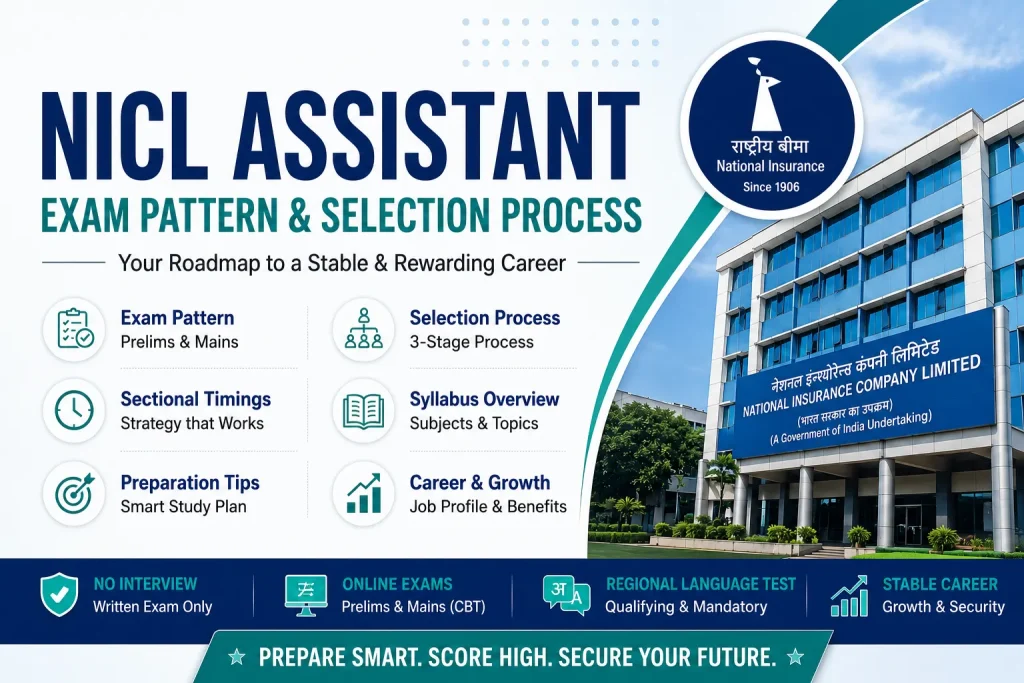
Latest Update Box
- NICL Assistant Notification 2026 released on 17th July 2026 for 500 Assistant vacancies.
- Online application window: 18th July 2026 to 7th August 2026.
- NICL Assistant Prelims Exam is scheduled for 27th August 2026.
- NICL Assistant Mains Exam is scheduled for 30th October 2026.
- Selection involves Prelims, Mains, and a Regional Language Test — there is no interview.
- Candidates should keep checking the official NICL website for admit card and exact exam city intimation, since exact dates can shift by a few days.
Expert Tip
Bookmark the official NICL careers page and set a weekly reminder to check it. Coaching websites update fast, but the notification PDF is the only document that is ever binding for exam-day rules.
Quick Highlights Table
| Particulars | Details |
|---|---|
| Conducting Body | National Insurance Company Limited (NICL) |
| Post | Assistant (Class III cadre) |
| Vacancies | 500 |
| Application Dates | 18th July – 7th August 2026 |
| Prelims Exam Date | 27th August 2026 |
| Mains Exam Date | 30th October 2026 |
| Selection Stages | Prelims, Mains, Regional Language Test |
| Interview | Not applicable |
| Mode of Exam | Online, Computer-Based Test |
| Prelims Questions/Marks | 100 Questions / 100 Marks |
| Mains Questions/Marks | 200 Questions / 200 Marks |
| Negative Marking | 0.25 marks per wrong answer |
| Prelims Duration | 60 minutes (sectional) |
| Mains Duration | 120 minutes (sectional) |
| Medium of Exam | English and Hindi (except English Language section) |
If you haven’t gone through the full notification yet, check out our detailed NICL Assistant Recruitment 2026 page for eligibility, vacancy breakup, and application details before you continue with the syllabus below.
What is NICL Assistant?
National Insurance Company Limited is one of India’s oldest public sector general insurance companies, and the Assistant post is a Class III clerical-level role that handles policy documentation, claims processing, customer service, and day-to-day branch operations. It is a stable, pensionable-culture government job with a respectable starting salary, regular increments, and a clear promotion path into higher cadres over the years.
For a fresh graduate — or even a 12th-pass candidate, since that is the minimum qualification for this post — it is one of the few insurance-sector jobs that does not demand a specialised degree, which is exactly why lakhs of candidates apply every recruitment cycle.
Key Takeaways
NICL Assistant is an entry-level insurance job open to 12th-pass and graduate candidates, selected purely through a written exam process with no interview stage.
NICL Assistant Selection Process
The selection process has three stages, and you need to clear all of them to get the final offer.
Stage 1 – Preliminary Examination: A screening-level online test covering English Language, Reasoning Ability, and Quantitative Aptitude. This stage is qualifying in nature — your Prelims score does not carry forward to the final merit list, but you must score above the qualifying marks (both overall and sectional) to move ahead.
Stage 2 – Main Examination: A longer, more detailed online test covering five sections — Reasoning, English Language, Numerical Ability, General Awareness, and Computer Knowledge. This is the stage that actually decides your merit ranking.
Stage 3 – Regional Language Test: Candidates who clear Mains are called for a test of the official regional language of the state or Union Territory they applied under. This is qualifying and mandatory — even a topper in Mains will be disqualified if they cannot prove basic reading and writing proficiency in the local language.
There is no interview in NICL Assistant recruitment. Final selection is based entirely on your Mains score, subject to clearing the Regional Language Test.
Expert Tip
Because there’s no interview to fall back on, every mark in Mains genuinely matters. Don’t treat Prelims casually just because it’s qualifying — a poor Prelims attempt eats into the time and mental energy you’ll need for Mains prep.
NICL Assistant Exam Pattern Overview
Before diving into section-wise numbers, it helps to understand the broad structure.
Mode: Both Prelims and Mains are conducted online as Computer-Based Tests (CBT), with objective-type multiple-choice questions.
Medium: Questions in Mains are set in both English and Hindi, except for the English Language section, which is obviously tested only in English. Prelims is also bilingual except for its English section.
Negative Marking: Both stages carry a negative marking of 0.25 marks for every wrong answer. There is no penalty for questions left unattempted.
Qualifying Nature of Prelims: Prelims marks are not added to your final score. They only decide who moves to Mains. You must clear both the overall cut-off and each individual sectional cut-off in Prelims.
Final Selection: Based on the aggregate marks scored in Mains, followed by qualifying the Regional Language Test.
Key Takeaways
Two separate online exams, sectional time limits in both, uniform negative marking of 0.25 across stages, and a final merit list built entirely from Mains marks.
NICL Assistant Prelims Exam Pattern
The Prelims exam is a 60-minute test split into three timed sections of 20 minutes each. You cannot borrow time from one section to attempt another — once your 20 minutes for English is up, that section locks automatically and you move to the next.
| Subject | Questions | Marks | Duration | Medium |
|---|---|---|---|---|
| English Language | 30 | 30 | 20 minutes | English |
| Reasoning Ability | 35 | 35 | 20 minutes | English/Hindi |
| Quantitative Aptitude | 35 | 35 | 20 minutes | English/Hindi |
| Total | 100 | 100 | 60 minutes | — |
Sectional Timing: This is the single most important thing to internalise about Prelims. Many candidates who are otherwise strong in Quant end up underperforming simply because they didn’t practise under a 20-minute sectional clock and ran out of time mid-puzzle in Reasoning.
Negative Marking: 0.25 marks deducted for every wrong answer across all three sections.
Difficulty: Prelims difficulty for NICL Assistant has historically ranged from easy to moderate, noticeably friendlier than Mains. Reasoning puzzles are usually of a manageable length, and Quant leans towards arithmetic rather than heavy Data Interpretation.
Common Mistakes: Candidates frequently spend too long on one tough puzzle in Reasoning and end up rushing (and making silly errors) in the last five questions of that section. Another common mistake is attempting Quant questions in the order they appear instead of picking easier topics like Simplification and Number Series first.
Key Takeaways
100 questions, 100 marks, 60 minutes with strict 20-minute sectional locks, and a difficulty level that rewards speed and accuracy over depth.
Expert Tip
In your last 15 days before Prelims, practise exclusively with sectional mock tests, not full-length ones. Sectional practice trains your brain for the exact time pressure you’ll face on exam day.
NICL Assistant Mains Exam Pattern
Mains is where the real battle happens. It’s a 120-minute test across five sections, each with its own individual time limit.
| Subject | Questions | Marks | Duration | Medium |
|---|---|---|---|---|
| Reasoning | 40 | 40 | 30 minutes | English/Hindi |
| English Language | 40 | 40 | 30 minutes | English |
| Numerical Ability | 40 | 40 | 30 minutes | English/Hindi |
| General Awareness | 40 | 40 | 15 minutes | English/Hindi |
| Computer Knowledge | 40 | 40 | 15 minutes | English/Hindi |
| Total | 200 | 200 | 120 minutes | — |
Reasoning: Mains-level Reasoning goes noticeably deeper than Prelims — expect longer, more layered puzzles (combination-based seating arrangements, multiple parameter puzzles), and trickier syllogism and inequality sets that need careful case-by-case elimination.
English: Along with Prelims-level topics, Mains English tests error spotting, sentence improvement, and vocabulary-based questions more rigorously, and the passages in Reading Comprehension tend to be longer and more inference-based rather than direct fact-lookup.
General Awareness: This section rewards candidates who have been reading news consistently for months, not those who cram for a week. It leans heavily towards banking and insurance awareness alongside standard current affairs.
Computer Knowledge: A high-scoring, low-time-investment section if prepared properly, since the syllabus is limited and largely fact-based rather than analytical.
Quantitative Aptitude: Mains Quant introduces heavier Data Interpretation sets (bar graphs, caselets, tabular data) on top of the arithmetic already tested in Prelims, and calculations are generally less rounded, demanding faster mental maths.
Sectional Timing and Marking: Every section has its own hard time limit, and the same 0.25 negative marking applies throughout.
A quick clarification on official versus advisory information: the questions, marks, and timings above come directly from the exam pattern structure NICL has followed in previous recruitment cycles and mirrors what is expected in 2026. The difficulty commentary, strategy suggestions, and “which section to attempt first” advice further below are preparation guidance based on exam trends — not official NICL statements.
Key Takeaways
200 questions, 200 marks, five sections each with independent time limits, and a difficulty jump from Prelims that especially shows up in Reasoning puzzles and Quant’s Data Interpretation.
Expert Tip
Attempt Computer Knowledge and General Awareness first if you’re confident in them — they’re usually the fastest 40 marks on the paper, and banking them early takes pressure off before you enter the longer Reasoning and Quant sections.
Difference Between Prelims and Mains
| Parameter | Prelims | Mains |
|---|---|---|
| Sections | 3 (English, Reasoning, Quant) | 5 (Reasoning, English, Numerical Ability, GA, Computer Knowledge) |
| Total Questions | 100 | 200 |
| Total Marks | 100 | 200 |
| Duration | 60 minutes | 120 minutes |
| Nature | Qualifying only | Counts towards final merit |
| Difficulty | Easy to Moderate | Moderate to Difficult |
| GA & Computer Knowledge | Not tested | Tested |
| Sectional Time Limit | 20 minutes per section | 30/15 minutes per section (varies) |
NICL Assistant Prelims Syllabus
| Subject | Important Topics | Difficulty | Preparation Priority |
|---|---|---|---|
| Reasoning Ability | Puzzles, Seating Arrangement, Syllogism, Coding-Decoding, Inequality, Blood Relation | Moderate | High |
| Quantitative Aptitude | Simplification, Number Series, Arithmetic, Data Interpretation basics | Moderate | High |
| English Language | Reading Comprehension, Cloze Test, Error Detection, Para Jumble | Easy to Moderate | Medium-High |
Reasoning Ability
Reasoning tends to be the section that either makes or breaks your Prelims attempt, mainly because it’s the most time-consuming when you haven’t practised the patterns enough.
Puzzle: This covers floor-based, box-based, and scheduling puzzles where you’re given scattered clues and need to arrange people, items, or events logically. NICL asks this because it directly tests analytical thinking under time pressure — a skill that’s genuinely useful in an insurance back-office role dealing with policy records. The most common mistake is trying to solve the puzzle in your head instead of drawing a proper grid; always sketch it out on rough sheet. Practice tip: start with easier puzzles daily and gradually move to floor-cum-box combination puzzles as your accuracy improves.
Seating Arrangement: Circular, linear, and double-row arrangements where direction (facing inward/outward) is the trickiest part. Candidates frequently forget to mark facing direction on their diagram, which throws off the entire arrangement. Always note down “facing centre” or “facing outside” clearly before placing anyone.
Coding-Decoding: Tests your ability to identify hidden patterns between letters, numbers, or words. NICL usually keeps this on the simpler side compared to more analytical PSU exams. The common trap is assuming the pattern from the first clue instead of verifying it across at least two examples before applying it.
Blood Relation: Family tree-based questions where a single misread relationship (like confusing “brother-in-law” with “brother”) derails the entire chain. Draw a family tree diagram every single time, even for questions that look simple.
Direction: Tests distance and direction sense using movement-based statements. A rough sketch with compass directions marked out avoids nearly all silly mistakes here.
Syllogism: Statement-conclusion based logic questions. Most candidates lose marks here not because they don’t understand the rules, but because they rush and skip drawing the Venn diagram. Always diagram it, even if it feels slow initially — speed comes with practice, not with skipping steps.
Inequality: Coded or direct inequality statements requiring you to combine relations and draw conclusions. Common mistake: forgetting to check both “either-or” cases when relations don’t combine directly.
Alphabet: Includes alphabet series, word formation, and letter-based reasoning. This is a quick-scoring topic if you’re comfortable with alphabet positions (forward and reverse) — worth memorising cold.
Ranking: Position-based questions (rank from top/bottom in a queue or list). Simple but error-prone if you misread whether the question is asking “from the top” or “from the bottom” — read twice before answering.
Input-Output: Step-by-step word/number rearrangement based on a given machine logic. Write out each step separately rather than trying to track the final answer mentally.
Data Sufficiency: Tests whether given statements are sufficient to answer a question, without solving it fully. The biggest mistake candidates make is trying to fully solve the problem instead of just checking sufficiency — that wastes precious time.
Key Takeaways
Reasoning rewards structured, diagram-based problem solving far more than mental shortcuts. Build the habit of writing everything down, even under time pressure.
Expert Tip
Time yourself on 10 puzzles daily with a strict 15-minute cap for all 10 combined once you’re past the basics. This builds the speed NICL’s sectional timing actually demands.
Quantitative Aptitude
Quant in NICL Assistant Prelims leans heavily on speed-based arithmetic, while Mains adds proper Data Interpretation on top.
Simplification and Approximation: The fastest-scoring topic if your BODMAS and squares/cubes/tables (up to at least 30) are strong. Aim to solve each question in under 20 seconds.
Quadratic Equations: Comparing two variables (x and y) to determine their relationship. A limited-scope topic that’s easy to master with formula practice — don’t skip it just because it looks intimidating.
Number Series: Missing number or wrong number series based on patterns like squares, cubes, or alternating operations. Practising at least 15-20 series daily builds pattern recognition speed quickly.
Data Interpretation: Tabular, bar graph, pie chart, and caselet-based questions that test calculation speed and comprehension together. This carries higher weightage in Mains, so build strong calculation shortcuts early.
Arithmetic Topics (Profit & Loss, SI & CI, Ratio, Average, Time & Work, Time-Speed-Distance, Boats & Streams, Partnership): These form the bulk of the Quant paper. Master the core formulas first, then move to shortcut techniques. Common mistake: memorising formulas without understanding the underlying logic, which falls apart the moment a question is framed differently from the textbook version.
Mensuration and Geometry: Usually a smaller but consistent chunk of questions — basic formulas for area, perimeter, and volume of standard shapes are enough; NICL rarely asks for advanced geometry theorems.
Probability: Occasionally tested, usually at a basic level. A quick revision of fundamental probability rules a week before the exam is sufficient.
Key Takeaways
Quant is largely about calculation speed and formula fluency rather than conceptual difficulty. Daily calculation practice (tables, squares, cubes, fractions) pays off more than solving complex problems.
Expert Tip
Keep a formula notebook from day one. Revising your own handwritten formula sheet the night before the exam works far better than re-reading a thick book.
English Language
English is often underestimated by candidates who assume they’re “already good at English” — but NICL’s English section tests grammar precision, not conversational fluency.
Reading Comprehension: Usually the highest-weightage topic in this section. Passages can be based on banking, economy, or general awareness themes. Practice tip: read the questions first, then the passage, to save time hunting for answers.
Cloze Test: A passage with blanks testing contextual vocabulary and grammar. Read the full passage once before attempting any blank — context matters more than the sentence in isolation.
Error Detection: Tests grammar rules like subject-verb agreement, tenses, and article usage. Common mistake: over-analysing a sentence and “finding” an error that doesn’t exist. If a sentence sounds grammatically correct on a calm re-read, it usually is.
Sentence Improvement: Similar to error detection but asks you to pick the best replacement for an underlined phrase.
Para Jumble: Rearranging jumbled sentences into a coherent paragraph. Look for the opening sentence (usually the one introducing the topic without pronouns like “it” or “this”) as your anchor point.
Fillers: Single or double blank sentence completion testing vocabulary and grammar together.
Vocabulary: Synonyms, antonyms, and word usage based questions — build this through consistent daily reading rather than last-minute word lists.
Word Swap: Identifying which two words in a sentence need to be swapped to make it grammatically correct.
Phrase Replacement: Choosing the grammatically correct alternative to an underlined phrase in a sentence.
Key Takeaways
English rewards consistent daily practice over cramming. Reading a newspaper editorial daily does more for your score than solving 50 random grammar MCQs the week before the exam.
Expert Tip
Maintain a small vocabulary diary — five new words a day, with their usage in a sentence, revised weekly. By exam day you’ll have a working vocabulary of 300+ words without ever feeling like you “studied” vocabulary separately.
NICL Assistant Mains Syllabus
| Subject | Important Topics | Difficulty | Preparation Priority |
|---|---|---|---|
| Reasoning | Puzzles, Syllogism, Input-Output, Data Sufficiency | Moderate to High | High |
| English Language | RC, Error Spotting, Vocabulary, Sentence Improvement | Moderate | High |
| General Awareness | Banking Awareness, Current Affairs, Static GK | Moderate | High |
| Computer Knowledge | MS Office, Internet, Networking, Number System | Easy | Medium-High |
| Quantitative Aptitude | Data Interpretation, Arithmetic, Quadratic Equations | Moderate to High | High |
Reasoning (Mains): Everything covered in Prelims Reasoning applies here too, but expect longer puzzle sets with multiple parameters (age, floor, profession, all combined in one puzzle) and trickier syllogism/inequality combinations.
English (Mains): Builds on Prelims topics with a stronger focus on error spotting and vocabulary-based questions, plus longer, more analytical Reading Comprehension passages.
General Awareness: This is the section that most separates well-prepared candidates from the rest, since it can’t be solved through logic on exam day — either you know it or you don’t. It covers current affairs of the last 6-8 months, banking and insurance awareness (RBI/IRDAI policies, insurance terms, recent financial schemes), and static GK (important days, awards, books and authors, headquarters).
Computer Knowledge: Covers computer fundamentals, MS Office (Word, Excel, PowerPoint shortcuts and functions), Internet basics, networking terms, number systems, and operating system basics. This is a syllabus you can genuinely finish in two to three weeks with consistent daily revision.
Quantitative Aptitude (Mains): Same core arithmetic topics as Prelims, but with meaningfully more Data Interpretation questions and marginally tougher calculation values.
Key Takeaways
Mains syllabus doesn’t introduce entirely new topics over Prelims (except GA and Computer Knowledge) — it deepens the same topics with added complexity and two brand-new scoring sections.
Expert Tip
Since GA and Computer Knowledge weren’t tested in Prelims, start these two subjects only after clearing Prelims, once you know for certain you’re moving to Mains — don’t split your limited pre-Prelims time across five subjects when only three matter at that stage.
Regional Language Test
The Regional Language Test is often the most misunderstood part of this entire process.
Purpose: NICL requires Assistants to be able to communicate with customers and handle documentation in the local language of the state or UT they’re posted in, since a large part of an Assistant’s job involves direct customer interaction at branch level.
Qualifying Nature: This is not scored towards your merit list. You either qualify or you don’t — but failing it means disqualification regardless of how well you scored in Mains.
How Candidates Should Prepare: If you applied for a state where the regional language isn’t your mother tongue, don’t leave this for the last week. Basic reading and writing fluency (not literary-level command) is what’s tested, so a few weeks of focused practice — reading local newspapers, practising basic writing — is usually sufficient.
Common Misconceptions: Many candidates assume this is a formality that “everyone clears.” That’s not accurate — every year, some Mains-qualified candidates get disqualified at this stage purely because they underestimated it. Treat it as seriously as Mains itself if the regional language isn’t one you’re fully comfortable in.
Key Takeaways
Don’t treat the Regional Language Test as a rubber stamp — it has real disqualification power, and preparing for it should start the moment you clear Mains, not after.
High Weightage Topics
| Subject | Topic | Importance | Reason |
|---|---|---|---|
| Reasoning | Puzzle & Seating Arrangement | Very High | Largest question chunk across both stages |
| Reasoning | Syllogism | High | Consistently asked, high accuracy possible with practice |
| Quant | Data Interpretation | Very High | Heavier weightage in Mains, tests speed and accuracy together |
| Quant | Simplification/Approximation | High | Fastest-scoring topic if calculation speed is strong |
| English | Reading Comprehension | High | Largest weightage within English section |
| English | Error Spotting | High | Frequently and consistently tested in Mains |
| GA | Banking & Insurance Awareness | Very High | Directly relevant to the job role, heavily tested |
| Computer | MS Office & Internet Basics | Medium-High | Limited syllabus, easy to master fully |
Difficulty Analysis
Easy Topics: Simplification, Approximation, Alphabet Test, Computer Fundamentals, Coding-Decoding.
Moderate Topics: Seating Arrangement, Syllogism, Reading Comprehension, Arithmetic word problems, Number Series.
Difficult Topics: Complex multi-parameter Puzzles, Data Interpretation-based caselets, Inequality with combined statements, and current affairs-heavy General Awareness questions.
This difficulty grading is based on how previous NICL Assistant papers and similar insurance-sector recruitment exams have trended — it is not an official difficulty classification from NICL, since the actual paper difficulty can vary each year.
90-Day Study Plan
| Days | Focus Area |
|---|---|
| Day 1–15 | Build Reasoning and Quant basics; start daily vocabulary and RC practice |
| Day 16–30 | Complete English grammar topics; start Puzzle and DI practice |
| Day 31–45 | Full Prelims-level topic coverage; begin sectional mock tests |
| Day 46–60 | Prelims revision + start GA and Computer Knowledge basics |
| Day 61–75 | Full-length Prelims mocks + Mains-level Reasoning and Quant depth |
| Day 76–90 | Full Mains mock tests, error analysis, and revision of weak areas |
60-Day Study Plan
| Days | Focus Area |
|---|---|
| Day 1–10 | Quant and Reasoning fundamentals, daily vocabulary |
| Day 11–25 | English grammar + Puzzle practice + sectional tests begin |
| Day 26–40 | Full Prelims syllabus coverage + regular sectional mocks |
| Day 41–50 | GA and Computer Knowledge basics + Mains-level Quant/Reasoning |
| Day 51–60 | Full-length mocks (Prelims and Mains) + revision |
30-Day Revision Plan
| Days | Focus Area |
|---|---|
| Day 1–7 | Topic-wise revision of Reasoning and Quant weak areas |
| Day 8–14 | English grammar revision + daily RC and vocabulary practice |
| Day 15–21 | GA current affairs revision (last 6 months) + Computer Knowledge |
| Day 22–27 | Full-length mock tests daily with error analysis |
| Day 28–30 | Light revision only, formula sheets, no new topics |
Expert Tip
In the last 30 days, resist the temptation to start new topics — even if you feel a gap. Revision of what you already know beats fragmented last-minute learning almost every single time.
Daily Study Timetable
For College Students
| Time | Activity |
|---|---|
| 6:00–7:00 AM | Reasoning practice |
| 7:00–7:30 AM | Vocabulary + newspaper reading |
| After college (2 hrs) | Quant + English practice |
| Before bed (1 hr) | GA revision + formula sheet review |
For Working Professionals
| Time | Activity |
|---|---|
| Early morning (1 hr) | Quant or Reasoning practice |
| Lunch break (20-30 min) | Vocabulary or GA reading |
| Evening (1.5–2 hrs) | Full topic practice + mock test (alternate days) |
| Weekend | Full-length mock tests + revision |
For Full-Time Aspirants
| Time | Activity |
|---|---|
| 6:00–8:00 AM | Reasoning practice |
| 9:00–11:00 AM | Quant practice |
| 12:00–1:30 PM | English + vocabulary |
| 3:00–4:30 PM | GA + Computer Knowledge |
| 5:00–6:30 PM | Mock test / sectional test |
| 7:00–8:00 PM | Error analysis and revision |
Preparation Strategy
Beginner: Start with NCERT-level grammar for English and basic arithmetic concepts for Quant before jumping into MCQs. Trying to solve exam-level puzzles without first understanding the logic behind them usually leads to frustration and slow progress.
Intermediate: Focus on speed-building through timed topic-wise tests, and start attempting sectional mocks regularly. This is also the stage to start tracking your accuracy percentage per topic, not just your score.
Advanced: Shift almost entirely to full-length mock tests, previous year papers, and detailed error analysis. At this stage, the goal isn’t learning new concepts — it’s fine-tuning attempt strategy, question selection order, and time allocation per section.
Key Takeaways
Your preparation strategy should evolve with your stage — beginners need concept clarity, intermediates need speed, and advanced aspirants need exam-day strategy refinement.
Common Mistakes
- Starting with mock tests before building basic concept clarity.
- Ignoring sectional time limits during practice and only doing untimed practice.
- Ignoring Computer Knowledge and GA until the last month, leaving too little time to build them properly.
- Solving puzzles mentally instead of drawing diagrams leads to careless errors.
- Not revising formulas regularly, causing them to be forgotten right before the exam.
- Attempting questions in the printed order instead of picking easier ones first within a section.
- Neglecting vocabulary building until the week before the exam.
- Not analysing mock test mistakes properly — solving more mocks without reviewing errors doesn’t improve scores.
- Underestimating the Regional Language Test and starting preparation for it too late.
- Overloading on study material from too many sources instead of sticking to one or two reliable sources per subject.
- Ignoring negative marking strategy and guessing blindly on unfamiliar questions.
Best Books
| Book | Subject | Best For |
|---|---|---|
| Quantitative Aptitude for Competitive Examinations – R.S. Aggarwal (Buy Now) | Quantitative Aptitude | Concept building and formula practice |
| A Modern Approach to Verbal & Non-Verbal Reasoning – R.S. Aggarwal (Buy Now) | Reasoning Ability | Topic-wise reasoning practice |
| Objective General English – S.P. Bakshi (Buy Now) | English Language | Grammar and vocabulary fundamentals |
| Word Power Made Easy – Norman Lewis (Buy Now) | English Language | Long-term vocabulary building |
| Banking Awareness Handbook (any updated edition) (Buy Now) | General/Financial Awareness | Static banking concepts and terminology |
Best Online Mock Tests
A good mock test series matters as much as your books do, because it’s the only way to genuinely simulate exam-day pressure and sectional timing. Oliveboard, PracticeMock, Guidely, and Smartkeeda are among the widely used platforms for NICL Assistant mock tests, each offering full-length tests, sectional practice, and detailed performance analytics. If you’re searching for an Oliveboard coupon code, PracticeMock coupon code, Guidely coupon code, or Smartkeeda coupon code before buying a test series, it’s worth comparing the latest offers on Karmasetu.in first — pricing and validity periods change fairly often, and a quick check can save you a meaningful amount.
Mock Test Coupons
| Platform | Coupon Code | Discount |
|---|---|---|
| Oliveboard Coupon Code | CEOB20 | Maximum discount |
| PracticeMock Coupon Code | COUPONEDGE | 69% off |
| Guidely Coupon | CEDGE12 | Extra 12% off |
| Smartkeeda Coupon | COUPONEDGE | Maximum discount |
Previous Year Paper Strategy
Previous year papers of NICL Assistant (and closely related exams like NIACL Assistant and LIC Assistant, which follow a similar pattern) are one of the most underused resources by aspirants. Solve at least 5-6 previous year papers strictly under timed conditions in your final month, and instead of just checking your score, go back and note which topics repeatedly appear — puzzle types, GA categories, grammar rule patterns. This pattern recognition is often more valuable than solving another fresh mock test.
Expected Difficulty Level
Based on previous NICL Assistant exam cycles and similar insurance-sector recruitment patterns, Prelims is expected to stay in the easy-to-moderate range. At the same time, Mains typically pushes into moderate-to-difficult territory, especially in Reasoning and Quant. This assessment is based purely on historical exam trends and general pattern analysis — it is not an official prediction from NICL, and actual difficulty can vary in any given exam cycle.
Expert Preparation Tips
- Treat Prelims and Mains preparation as one continuous timeline rather than two separate phases — the core Reasoning, Quant, and English syllabus overlaps almost entirely.
- Build a genuine daily current affairs habit at least 3-4 months before Mains, since GA cannot be crammed effectively in a short window.
- Track your own accuracy percentage topic-wise, not just your overall mock score — a 60% overall score can hide a 90% accuracy in Quant and a 30% accuracy in Reasoning, and you need to know which is which.
- Give at least one full-length mock test under exact exam-day timing conditions every week once you’re in the last two months of preparation.
- Don’t attempt every question in a section — a wrong guess costs you 0.25 marks, so skip questions you’re genuinely unsure about rather than gambling on all of them.
- Revise your own error log (a simple notebook of mistakes from every mock test) the night before the actual exam instead of reading new material.
Frequently Asked Questions
The syllabus covers Reasoning Ability, Quantitative/Numerical Ability, and English Language for Prelims, with General Awareness and Computer Knowledge added for Mains.
Prelims has 100 questions/100 marks in 60 minutes across three sections, while Mains has 200 questions/200 marks in 120 minutes across five sections, both with sectional timing.
Yes, 0.25 marks are deducted for every wrong answer in both Prelims and Mains.
No, there is no interview. Selection is based on Prelims (qualifying), Mains (merit-based), and the Regional Language Test (qualifying).
There are three stages — Prelims, Mains, and the Regional Language Test.
No, Prelims is purely qualifying in nature. Only Mains marks count towards the final merit list.
Both 12th-pass and graduate candidates are eligible to apply, subject to age and other conditions specified in the official notification.
The notification released on 17th July 2026 announced 500 Assistant vacancies.
Online applications are open from 18th July 2026 to 7th August 2026.
The Prelims exam is scheduled for 27th August 2026.
The Mains exam is scheduled for 30th October 2026.
Both English and Hindi, except for the English Language section, which is tested only in English.
Five sections — Reasoning, English Language, Numerical Ability, General Awareness, and Computer Knowledge.
60 minutes in total, divided into three sections of 20 minutes each.
120 minutes in total, with each section having its own individual sectional time limit.
No, it is qualifying in nature but mandatory for final selection.
The candidate is disqualified from the recruitment process regardless of their Mains performance.
Puzzles, Seating Arrangement, and Syllogism have historically carried the highest weightage.
No, it has a limited, largely factual syllabus and can be prepared thoroughly within 2-3 weeks of consistent effort.
Conclusion
The NICL Assistant exam isn’t about being naturally brilliant at Reasoning or having read every newspaper since childhood — it’s about consistent, structured effort over the next few weeks, applied to a syllabus you now understand completely. You know exactly what’s being tested, how much time you have, how marks are distributed, and where the high-weightage topics lie. That’s more than most candidates walking into this exam will have.
Build your study plan around the timelines here, track your mock test errors honestly, and keep revisiting the official notification for any updates. Karmasetu.in will keep this page updated as new information comes in — bookmark it, and get started today.

Karmasetu is a dedicated team of government job researchers and exam
enthusiasts based in West Bengal. With a combined experience of tracking
central and state government recruitments across India, the team covers
SSC, Railway, Banking, Defence, and State PSC notifications — verified
directly from official sources.
Our goal is simple: give every job seeker in India accurate, timely,
and easy-to-understand recruitment information so they never miss an
opportunity. Every article on Karmasetu is written after reading the
official notification PDF, cross-checked for eligibility details, and
updated whenever official changes are announced.
Follow us on Telegram (@karmasetu) for instant job alerts.
